Sunday, 16 October 2022

Why Marriage Is Hard Work - Two Psychometric Models Provide An Answer

This insight crept up on me rather gradually. There is a fundamental tension that is inherent in the necessary ingredients of a successful marriage, and it takes conscious effort to overcome this tension.

Two psychometric models explain this tension well, and their creators are Donald O. Clifton and William Edward "Ned" Herrmann. I learnt about both of these models as a result of short courses that I had the privilege to be nominated for during my career. I probably wouldn't have come across them otherwise.

1. "Strengths-Based Psychology" by Donald O. Clifton

The testing tool invented by Donald Clifton has been known by several names - The Gallup Test, StrengthsFinder, Gallup Strengths Assessment and Clifton Strengths Test.

It describes 34 themes that make up a person's personality.

  1. Achiever - a constant need for achievement
  2. Activator - impatience for action
  3. Adaptability- ability to respond to the demands of the moment
  4. Analytical - objective and data-driven
  5. Arranger - ability to manage all the variables in a complex situation to produce the most productive configuration
  6. Belief - possessing enduring core values
  7. Command - ability to take charge
  8. Communication - ability to make people listen to you
  9. Competition - the desire to win
  10. Connectedness - awareness of the interconnectedness of all beings, and the resulting sense of responsibility
  11. Consistency - preference for balance, fairness, predictability
  12. Context - orientedness due to an ability to join the dots
  13. Deliberative - risk-aware and careful
  14. Developer - ability to see potential in everyone
  15. Discipline - dealing with an unpredictable world through structure that you impose
  16. Empathy - seeing the world through the eyes of others
  17. Focus - having a clear destination
  18. Futuristic - inspiration from what can be
  19. Harmony - ability to find common ground and reduce conflict
  20. Ideation - the ability to find new perspectives to explain phenomena and address challenges
  21. Includer - accepting of all, non-judgemental
  22. Individualisation - ability to draw out the best in each person
  23. Input - tendency to collect facts and objects in the hope that they will one day prove useful
  24. Intellection - introspective, fond of thinking
  25. Learner - excited by new knowledge
  26. Maximiser - in constant quest of excellence
  27. Positivity - contagious enthusiasm
  28. Relator - trusting, sharing, risk-taking in vulnerability
  29. Responsibility - taking ownership of tasks
  30. Restorative - energized by challenge, finds solutions to seemingly unsolvable problems
  31. Self-Assurance - confidence not only in one's abilities but also in one's judgement, natural acceptance of accountability
  32. Significance - need to stand out, to be recognised, a striving to be exceptional
  33. Strategic - ability to see patterns where others see complexity, to see around the next corner, to make selections that work
  34. WOO - Winning Others Over, can break the ice, strike up conversations with strangers and making connections

I learnt about the Strengths-based model in the context of organisational team-building. I learnt to accept that people weren't all the same, that they had different strengths, and that rather than try to fix weaknesses in their people, the aim of a manager should be to put together teams of people with complementary strengths, so that the team as a whole could deliver effectively on all its tasks.

This was a rather refreshing approach to management. I had heard of the approach of "playing to one's strengths" in the context of individual self-development, but I was hearing it for the first time in the context of team-building. Organisations need not worry too much about deficiencies in their people. They just have to make sure that their teams as a whole are able to make up for the deficiencies of the individuals they're comprised of.

For example, I worked in the IT Architecture division of several companies, and our job was to "guide investment and design decisions around technology". Not everyone in our team had identical strengths. For example, some were deep thinkers who could come up with innovative models, but who lacked the ability to communicate these ideas effectively and convince other people. There were other people in the team, though, who may not have had the same ability to create models, but who could create effective visualisations of these models such that they were instantly understandable to decision-makers. Together, these two groups of very different people were effective in creating and communicating innovative solutions to the rest of the organisation. That was a practical example to me of complementary skills being effective in an organisational context.

2. The "Herrmann Brain Dominance Instrument" by William Herrmann

To my mind, the Herrmann Brain Dominance Instrument (HBDI) is a far more insightful and useful model than the two other models commonly used by organisations - Myers-Briggs Personality Types and the DISC Profile. Unfortunately, this excellent test is not available free of charge, and it is usually only administered through organisational sponsorship.

HBDI identifies four unique thinking styles that people tend to use in various combinations. Some people have a single, dominant thinking style. Others have a combination of two, three or all four, with each style having a certain "weight" relative to the other three.

Each thinking style is given a colour code.

  • Blue - Logical, Analytical, Fact-based, Quantitative
  • Yellow - Holistic, Intuitive, Integrating, Synthesising
  • Red - Interpersonal, Feeling-based, Kinesthetic, Emotional
  • Green - Organised, Sequential, Detailed, Risk-aware

These thinking styles are then mapped to the four quadrants of a circle, with blue on the top left, yellow on the top right, red on the bottom right, and green on the bottom left.

Thus, blue and red are in opposing quadrants, just as yellow and green are in opposing quadrants. These pairs of thinking styles are completely "opposite" to one another.

More interesting are the adjacent thinking styles. They have certain common traits. The reason is that the four directions of the circle represent certain modes of thinking.

  • Left - The "left brain", realistic and commonsensical
  • Right - The "right brain", idealistic and intuitive
  • Top - the "cerebral" brain, cognitive and pragmatic
  • Bottom - the "limbic" brain, visceral and instinctual

Adjacent colours therefore have a certain affinity.

  • Blue and Yellow are both cerebral rather than limbic. They think cognitively about things rather than react viscerally.
  • Yellow and Red are both right-brained. They rely on feeling and intuition rather than pure logic.
  • Red and Green are both limbic rather than cerebral. They have instinctive reactions to situations.
  • Green and Blue are both left-brained. They are grounded and realistic.

One of the core themes in a course on HBDI (after all participants have been tested and assessed as to which quadrant(s) they belong to) is the challenge of communication. In an organisation, people need to communicate with others, explain their perspectives on situations, negotiate for resources, convince decision-makers in favour of one or another option, etc. When people have very different thinking styles, they can often talk past one another instead of connecting. This is because people are used to expressing ideas from their own perspective, and this perspective may make little sense to a person with a very different thinking style, who is used to seeing things in a very different way.

Effective communication requires a knowledge of the other person's thinking style, and a formulation of one's argument in terms the other person can naturally understand.

Communication between people with thinking styles in adjacent quadrants is relatively easier than communication between people in opposite quadrants. They can rely on certain common thinking modes to find common ground. It is a far more difficult task for people in opposite quadrants to be able to communicate meaningfully.

It is common for people in the Blue quadrant to believe that they are "superior" thinkers, but the HBDI consultants take great pains to emphasise that this is not so. None of these four thinking styles is "superior" to any other. Each has its own strengths. It is necessary for people to treat their colleagues with respect, regardless of what their predominant thinking style is, and to make honest efforts to communicate with them in a way the other person can understand.

Marriage and the Confluence of the two Models

It struck me somewhere along the journey of my own marriage that the notions of complementary strengths and thinking styles were both hugely relevant to the way my wife and I interpreted life events and responded to them. We have had arguments and conflicts, and we have also had successes and triumphs. This is the distillation of my thoughts.

Marriage is fundamentally teamwork. Two individuals embark on a lifelong project together, and they deal with a multitude of challenges as they go along, with specific tasks and deliverables expected at various life stages. Building meaningful careers, balancing life and work, raising children, buying a home, investing for retirement, dealing with the pressures of extended family, dealing with unexpected events like illnesses, job stress, financial hardship, etc., are part of the never-ending sequence of life events that a couple must confront and overcome together.

It is unrealistic to expect that each of the individuals in a marriage is a perfectly balanced individual with all the strengths required to deal with life's vicissitudes. The most pragmatic solution is therefore for the couple to have complementary strengths, so that between the two of them, they have the ability to deal with a greater proportion of challenges than either of them could alone.

However, complementary strengths come with their own inherent problem, and this is the tension I referred to earlier. Strengths are related to thinking styles, and complementary strengths are likely to be related to thinking styles in opposite quadrants. As we know, communication is difficult between people with different thinking styles, because they see situations very differently, and find it hard to understand or convince the other of their respective points of view.

It may seem ideal for a couple to have identical thinking styles. They can then understand each other most naturally, and the possibility of conflict between them may seem low. But two people who think alike are likely to share the same blind spots. Over the long haul, as they face a multitude of different life challenges, it is possible that they may make some costly mistakes because in their case, two heads are no better than one. Mistakes and failures can then introduce a different set of stresses into the marriage.

It may seem depressing to conclude that there is no ideal marriage, after all. A couple needs to have complementary strengths to be able to negotiate the gamut of life's challenges successfully over the long haul, yet complementary strengths imply different thinking styles, which make communication a challenge.

It needn't be depressing at all, though! The flip side of the coin is that a couple with mutual respect and trust, who put in the effort to understand each other's thinking styles, and who consciously learn to communicate in a way that the other can understand, can get the best of both worlds. They can function effectively as a team, and kick goal after goal.

[If you liked this post, check out a related one - "An Absurd Question, A Cop-Out Answer - Review Of Movie "What's Love Got To Do With It?""

Tuesday, 13 September 2022

Movie Review - Three Thousand Years Of Longing

[No spoilers, don't worry.]

I saw this movie earlier this evening at the cinemas, and thought it was interesting enough to write about.

This won't be my usual style of review. That's because I see this movie as being composed of two layers - an original plot premise, and a certain style of execution.

I'll first extract that plot premise as I understand it, and lay it out for you in distilled form.

Then I'll try to tease out the various core themes and lines of tension that the plot presents, which may then suggest various creative means to resolve them.

Finally, I'll evaluate how well the movie actually delivered on this plot premise, both in terms of storytelling and in terms of cinematography.

Plot premise

The protagonist is a modern-day single woman, a middle-aged professional who has seen a few ups and downs in her life and reached a stage of philosophical equanimity. The story begins when she comes across an interesting-looking bottle in a Middle Eastern bazaar during one of her travels, and buys it. Back in her hotel room, she opens the bottle and out comes a genie who grants her three wishes.

The interesting twist here is that the woman is genuinely contented and does not wish for anything, which surprises the genie.

Besides, she has heard too many stories (and jokes) about this wish-granting business ending badly, to risk falling into the same trap.

The genie needs her to make three wishes, otherwise he will never be free. He understands that the stories she has heard have made her suspicious of genies as tricksters. He then tells her his own life story, about the three times he ended up being imprisoned in the bottle.

The woman then does something.

That's the plot premise. The job of the storywriter is to flesh this out into a captivating story.

Core themes and lines of tension

1. The inner tension between contentment and making a wish - what happens? Does one triumph over the other, or is there another creative way to resolve this conflict?

2. The suspicion that genies are tricky characters not to be trusted - is this suspicion justified? The story could take either tack and run with it.

3. What stories would the genie tell the woman? Ostensibly, they are just a narrative of whatever happened to him, but their ulterior purpose is to overcome her reluctance to make three wishes. So what would the stories be? Would they be true stories, lies, or half-truths? Put together, what course of action would they compel her to take?

4. How would the movie's finale resolve all of these tensions satisfactorily? The genie's selfish motives, the unresolved question of the genie's own trustworthiness, the woman's suspicion of making wishes, her genuine contentment and absence of desire, and the suggested cumulative moral of the genie's three stories - how would they all play out?

Execution

To put it bluntly, the movie disappointed me, because I have grown to expect far more intelligent and creative storytelling approaches in modern films. Any number of talented storywriters could have picked up this plot premise and run with it in different brilliant directions.

First, the genie's own stories, while mildly interesting, did not seem to provide any significant lessons. Neither did they provide plot elements that played out in the present day with the protagonist.

Second, the events in the present day, while touching upon elements of modernity, science and technology, did not leverage them in any meaningful way. An early scene shows a speaker on a stage talking about storytelling and narrative, and suggests that advances in modern science and our understanding of the world have dispelled many of the mysteries that in earlier days were attributed to metaphysical phenomena. This is an extremely intriguing idea that makes us wonder how the genie phenomenon would be explained in scientific terms in today's world, but this is dealt with in a very superficial and unconvincing way. Hand-waving about electromagnetism and organic matter isn't enough for an audience used to sophisticated science-fiction.

Third, the protagonist's core character was not leveraged effectively enough. There should have been a dramatic development that both resolved a moral dilemma and heightened the audience's appreciation of her character. If there was one, it was rather weak.

Fourth, there was no satisfying denouement that closed the narrative loop, no "Chekhov's gun" earlier in the plot, for example, that popped up again at the climax to play a pivotal role.

In short, the storytelling was disappointing.

The cinematography was vivid and colourful, providing a swift panorama of Middle Eastern "history" over three thousand years to the present day. This part was well done. (If I had to make a wish, it would be never to be born into a palace. The stress induced by all the intrigues would get to me long before any assassins could.)

Final score: 3 stars out of 5. That's for the original plot premise and the cinematography. Better creativity in fleshing out the plot would have earned it a 4 or a 4.5.

Thursday, 7 July 2022

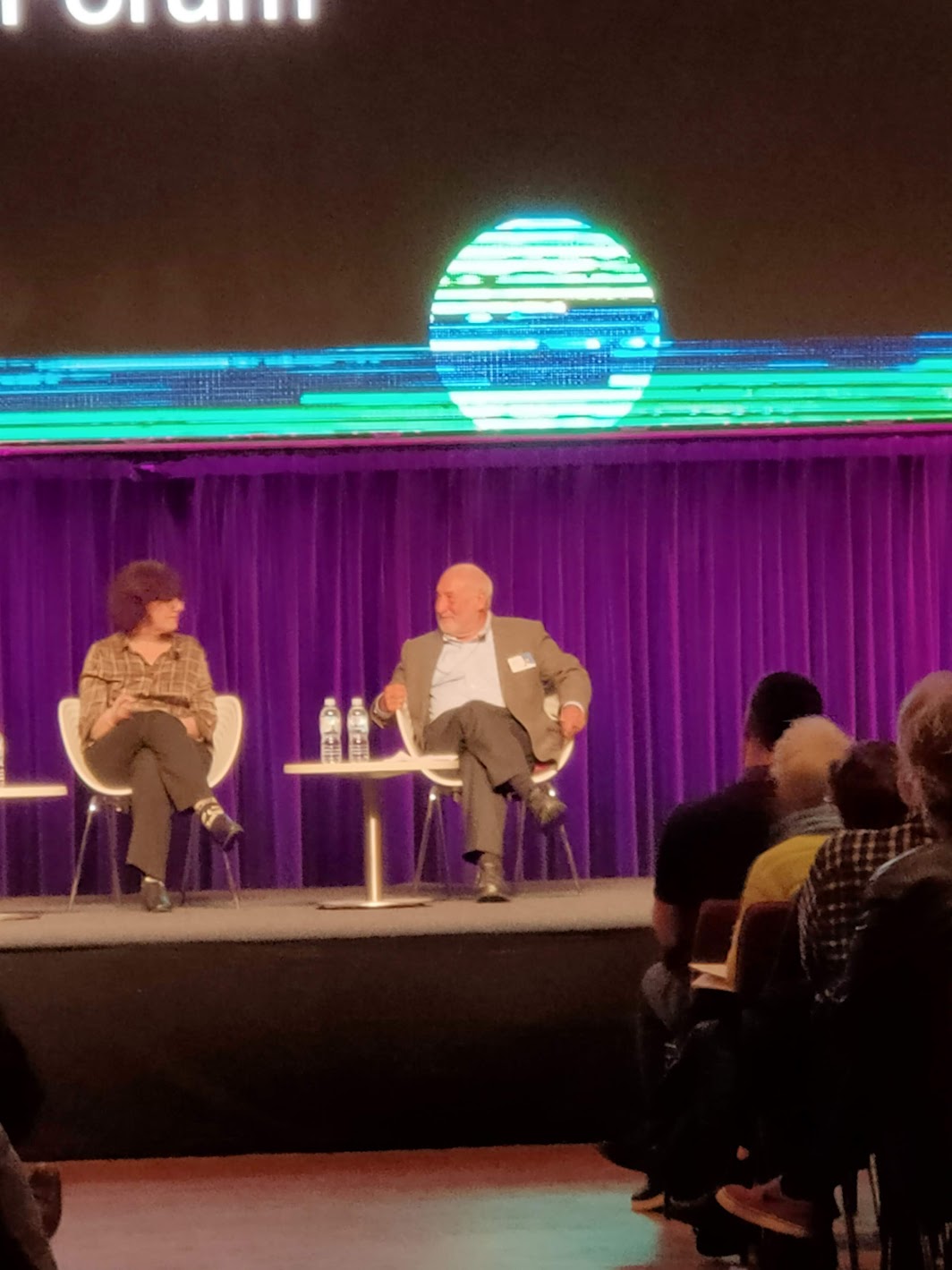
Professor Joseph Stiglitz's Talk At UTS

I got an email announcing that the Nobel Laureate Professor Joseph Stiglitz was in Australia, and that he would be addressing a crowd at the University of Technology, Sydney (UTS) on Thursday the 7th of July. So I registered for this free event and turned up for it. It was a strictly one-hour affair, which drastically reduced the time allowed for audience questions.

Prof. Stiglitz made the following points, and I took quick notes. (He said he was going to make 5 points, but then he made 6.)

1. Human progress was static for centuries, then standards of living and life expectancy started to increase rapidly after the 18th century. The reason is science and technology, and societies have learnt to organise themselves to harness science and technology. An important mindset that we gained from the Enlightenment was that progress is possible. Enlightenment values include democracy and tolerance for other viewpoints. In the US, these enlightenment values are being challenged today. What is at stake is every aspect of our progress including democracy. We need to re-learn the values of the Enlightenment.

2. Innovation cannot be taken for granted. It is endogenous. We can hasten or undermine it through our conscious choices.

3. Since Adam Smith, many economists have believed that markets would lead to progress in society. In the 1950s, the economist Gerard Debreu (later a Nobel laureate himself) studied under what conditions this would occur. He realised that information wasn't perfect, and markets weren't perfect. Along with Bruce Greenwald, Stiglitz himself argued that markets weren't always good for society. Innovation isn't automatic. Joseph Schumpeter argued that competition spurred innovation. He was wrong (in more than one way, actually), because it didn't always spur the right kind of innovation. For example, reducing labour isn't as important as reducing carbon emissions, but because markets reward labour-reducing innovations, those tend to occur more. Social returns are not the same as private returns. Curing malaria is more important than stopping hair loss, because millions of people die of malaria every year. But these deaths occur in poor countries, and the people there don't have the money to pay for a cure. But rich and insecure men have plenty of money to spend on hair loss prevention techniques, hence the latter area sees more market funding for innovation. There are also "me-too" innovations that are intended just to sidestep patents. They don't add any additional value socially. Markets also stay away from risky investments. Hence some of the most important innovations come from the public sector, because governments aren't that risk-averse. Knowledge is a public good. It shouldn't be hoarded, but private enterprises tend to keep knowledge to themselves, which isn't good for society. Thomas Jefferson said a candle doesn't diminish if it lights another. Government needs to get larger as we become a science-based society.

4. Research is an enquiry into the unknown. There will be failures. If a process doesn't see enough failure, it's not exploring boldly enough. The US government gave Tesla a lot of money, and that's why Tesla became successful. In Stiglitz's opinion, the government should have bought shares in Tesla instead of just giving the company money, so that the public would have got a return on its investment. Incidentally, government tends to get a higher return on its investments compared to the private sector. Although people say government should get out of the business of doing business, this is not justified based on results.

5. Government should not only support basic research, but should also steer the private sector. However, industrial policy is controversial. People say, "Governments shouldn't pick winners." But this happens anyway. Governments' decisions are always steering the economy. When people aren't paying attention, special interests end up steering the economy. Like derivatives which exploded. Derivatives got first preference when companies went bankrupt. This was a law passed through Congress because of lobbying by financial firms. So if governments are going to have an impact anyway, it's better that it make conscious steering decisions, such as adopting an education policy, a tax policy, etc., which would result in societal benefits. Current tax policy steers the economy towards saving labour, which creates more unemployment at a time when people are suffering economic hardship. Saving on labour does not result in societal well-being.

6. Government is beginning to talk about "well-being budgeting". Markets may be maximising profits and GDP, but not societal well-being. Technology policy is an important part of public policy.

After his talk, there was a brief discussion with a panel member, who asked a couple of questions, and Prof. Stiglitz answered.

There was time for just one audience question. I had a question, but didn't get a chance to ask it.

For what it's worth, this would have been my question.

"Prof. Stiglitz, you spoke about societal well-being, and you also touched upon democracy. One of the intriguing phenomena in today's world is -- China. China is not a democracy in the way we understand democracy, but after the death of Mao Zedong, all subsequent Chinese governments seem to have been very focused on improving the quality of life of the Chinese people. Hundreds of millions of people have been lifted out of poverty in a single generation. The government executes a series of Five Year Plans, all of which are focused on investing in sectors that require the most attention. For example, China lays thousands of kilometres of high-speed rail every year. This is particularly relevant to us in Sydney because we have seen our government take years and spend billions of dollars just to build a few hundred kilometres of metro rail. China seems to get more bang for the buck. We pride ourselves on our democracy, and we believe that democracy is about responsive government that delivers good governance, but it seems to me that a non-democratic government like China is showing up democratic ones in terms of the societal well-being that it has been able to deliver to its people in just a few decades.

What are your thoughts on this?"

Saturday, 16 April 2022

A Logo Suggestion For Fibonacci Coffee

There is a brand of coffee in Australia called Fibonacci Coffee. The logo has a nice spiral, indicating that the owners are well aware of the Fibonacci series and its mathematical characteristics.

It struck me that the logo and brand name could do with a subtle tweak that further reinforced its mathematical pedigree.

I believe I suggested this to them a while ago on some forum but didn't hear back from them.

Oh, well.

Wednesday, 30 March 2022

The Wrath Of Revenge That Russia's Rulers Rue (How A Wronged Brother, Father And Grandfather Came Back To Haunt A Country)

A videoclip I recently saw provided some fascinating insights into the possible motivations of Victoria Nuland, the Undersecretary of State for Political Affairs in the Biden government, who was formerly Assistant Secretary of State for European and Eurasian Affairs when Obama was in power. It's almost two hours long, but worth listening to.

Victoria Nuland, of course, is known for her role in the 2014 coup in Ukraine, and was recently in the news for her embarrassing gaffe over American-funded bioresearch labs in Ukraine.

The video by Gonzalo Lira was revealing, because I didn't realise that Victoria Nuland has ethnic Russian origins. Why would she be working so hard against her native country then? Put simply, it's revenge, and I'll elaborate on this further on. But importantly, the video got me thinking about three different people from three consecutive generations of Russians who were motivated by revenge against the government or even the common people of Russia, because of what had been done to their families at the beginning of the twentieth century.

Lenin, or Vladimir Ilyich Ulyanov

It's well-known to all who have read Lenin's biography that his older brother Alexander, whom he adored, was executed by the government of Romanov Tsar Nicholas II for his role in a royal assassination plot.

Vladimir Ulyanov was already into the revolutionary movement in 1887 when his brother was executed, and that event is said to have greatly increased his fervour and determination to see the Tsar overthrown. Thirty years later in 1917, he finally succeeded. A few months after Lenin's Bolsheviks won power, the entire Romanov family was assassinated in the basement of the house where they were being held.

Ayn Rand, or Alisa Rosenbaum

Ayn Rand, the high priestess of Capitalism, was born in 1905 to a Russian Jewish family in St Petersburg. Her father was a pharmacist with his own shop. In 1917, when the Bolsheviks took power, they confiscated his business. She stayed on in the Soviet Union until she completed university in 1924, then shortly left on a visit visa to the United States, never to return.

We know how her early experiences with Communism shaped her attitudes towards the ideology.

Victoria Nuland

Victoria Nuland is the daughter of Sherwin Nuland, who was born Shepsel Ber Nudelman. Sherwin's father was Meyer Nudelman, who lived in Moldova, part of the Russian Empire. In 1907, the infamous anti-Semitic Kishinev Pogrom occurred, in which several Jewish people were killed. After that, Meyer Nudelman fled to the United States. His son Sherwin and granddaughter Victoria were born in the US.

As Gonzalo Lira's video explains, Meyer Nudelman appears to have had a major influence on both his son and his granddaughter. Victoria Nuland tellingly studied Russian Literature, Political Science and History for her BA degree from Brown University.

In time, she joined the US Diplomatic Service, and her actions in recent years have all been aimed at hurting Russia.

Revenge and Russia

Three tales of revenge, one from each generation, show us that Russia continues to reap the fruits of what it sowed in the early twentieth century.

It appears that revenge is a dish that can be served hot, lukewarm or cold.

Tuesday, 29 March 2022

Does India Have Agency When Dealing With China? Some Examples From Indian History

When debating with Indian friends over the right approach that India should take towards China, I first try to find common ground by asking a simple but crucial question:

Does India have independent agency when it comes to dealing with China?

In other words, can India make its own choices that can have significantly different outcomes, or is it just a helpless player forced along a certain path by forces of history, powerless to choose how to view and approach other countries?

You, the reader, should probably ponder this question and answer it for yourself before reading further. But before I talk about the answers I have heard in response to this question, I would like to reach back into Indian history to discuss some interesting tidbits.

Friends and enemies of the kingdom

Around 300 BCE, there lived an Indian scholar and thinker called Chanakya or Kautilya, who was an advisor to two emperors of the Maurya dynasty. His well-known treatise on statecraft called Arthashastra (literally “Economics”) contains sage advice to rulers on how to recognise and deal with adversaries. In this respect, the treatise can be considered India’s answer to Sun Tzu’s The Art of War and Machiavelli’s The Prince.

Kautilya had a rather cynical view of a kingdom’s friends and enemies. As he saw it, any kingdom that shared a border with one’s own was a natural enemy and hence a threat. The only allies of a kingdom were to be found on a neighbouring kingdom’s other borders, or in other words, “an enemy’s enemy is a friend”.

If one applies Kautilya’s reasoning to present-day India, Pakistan is a natural enemy for the simple reason that it shares a border with India. India’s allies are then to be found on Pakistan’s other borders, such as Afghanistan and Iran.

In similar fashion, China is India’s natural enemy on account of the two countries sharing a border. India’s allies are to be found on the “other” side of China, such as Japan, the US and Australia. If Kautilya were around today, he would probably have approved of The Quad. That grouping reflects classic Kautilyan thinking.

Subjects of the kingdom

Fast-forwarding to the mid-16th century CE, we find the Mughal empire of Emperor Akbar dominating the Indian landscape. Adjoining his colossal empire were two small kingdoms. One was Mewar, ruled by the Rajput king Rana Pratap Singh. The other was Amer (or Amber), ruled by another Rajput king, Raja Man Singh. Akbar approached both kings seeking their cooperation in his federalist vision. His vassals would support the Mughal empire, which in turn, would protect them from their enemies.

The two Rajputs made opposite choices.

Rana Pratap’s pride would not allow him to become a Mughal vassal. He chose to fight Akbar’s empire.

Raja Man Singh allied with Akbar, even giving his sister in marriage to the emperor. He became one of Akbar’s trusted commanding generals in many campaigns, including one against Rana Pratap.

Indian history textbooks glorify Rana Pratap as a brave patriot who fought an invader. Raja Man Singh is barely mentioned.

What is interesting to consider is the fate of the subjects who lived in these two kingdoms.

The subjects of Mewar suffered the expected tribulations of a long war, as their king was first defeated and later fought his way back to some of his lost territories in a series of guerilla campaigns.

The subjects of Amer lived in relative peace and prosperity. Amer fort is just outside the modern city of Jaipur, and I had the opportunity to visit it. An interesting architectural feature of the fort is the Ganesh Pol, a huge archway built in the (Muslim) Mughal style, but with a picture of the Hindu god Ganesha at its crest. It indicates that Raja Man Singh was not forced to convert to Islam, but that he and his subjects continued to practise their religion even though they were a vassal state to a Muslim empire.

Fast-forward again to the 19th century, when the British were extending their rule over India. The kingdoms of Jhansi and Baroda provide a similar contrast in terms of the choices they made in dealing with the British empire.

Jhansi’s queen, Rani Lakshmibai, is the heroine of Indian history textbooks. She died fighting the British when they attempted to annex her kingdom.

Baroda’s king Sayyaji Rao Gaekwad III did not openly defy the British. He agreed to be a vassal king (although he had his own passive-aggressive ways of thumbing his nose at his British overlords). Indian history textbooks rarely mention him.

One can imagine what the subjects of Jhansi went through as a result of their queen’s choice. When Jhansi finally fell, the British spared no one, not even women and children. A British army doctor, Thomas Lowe, wrote, “No maudlin clemency was to mark the fall of the city.

Baroda’s citizens, in contrast, enjoyed the modernisation ushered in by their king under the peace he had negotiated with his British suzerein. In many ways, Baroda enjoyed a far more advanced society and lifestyle than the rest of British India.

History celebrates plucky and defiant rulers as heroes, and contemptuously ignores those who reach an accommodation with a superior power. Yet the lot of the common citizens of those rulers may have been quite the opposite of what the headlines of history mislead us into believing. (The plight of Ukrainians today under their indomitable leader President Zelensky is a topical example of this. Would ordinary Ukrainians have been better off if Zelensky had reached some sort of understanding with Russia instead of choosing confrontation?)

Agency, or the lack of it

Returning to the subject of agency, Kautilya’s model of statecraft admits of no choice at all on the part of a nation in deciding its enemies and allies. Geographical and political boundaries are held to determine these, and the rulers of a nation are mere receivers of a situation that is laid out for them.

If Indians accept the Kautilyan model of statecraft, then they implicitly acknowledge that India has no agency in determining who its enemies and allies are! In that case, continuing down the path of using the Quad to defend against China is an unavoidable strategy, no matter the consequences.

This argument is an uncomfortable one for many Indians, who like to have their cake and eat it too. They are proud of Kautilya for having given them a homegrown treatise on geopolitics and statecraft, but also insist that their country has independent agency!

OK, so let’s explore that angle as well. If India does have independent agency, then it has to choose how to deal with a much more powerful neighbour that expects deferential allyship. In many ways, India can see China as similar to Akbar’s Empire in terms of the deal it offers its neighbours — prosperity and internal autonomy in exchange for alignment and non-defiance. Should India defy this power, or seek an accommodation with it? In other words, should the Indian government act like Rana Pratap or Raja Man Singh? Like Rani Lakshmibai or Maharajah Sayyaji Rao Gaekwad? Accommodation does not have to mean surrender or appeasement, but the ability to negotiate a deal that wins autonomy for oneself while offering a non-threatening and cooperative relationship to the other.

As a democracy, it would be good for India’s government to make such a decision based on the likely outcome for India’s people. Defiance, as we have seen, often leads to hardship for common people. Accommodation, on the other hand, can result in peace and prosperity.

In sum, these would seem to be India’s choices today as it deals with an ever more powerful and assertive China — (1) accept the Kautilyan view that antagonism with a neighbour is inevitable (no agency), (2) exercise agency and choose defiance, or (3) exercise agency and choose accommodation.

As an ordinary citizen, which of these approaches would you like your government to take?

Wednesday, 23 March 2022

Australia's Overdue "Re-Orientation"

"Ultra Asia" (Beyond Asia) is an apt anagram for Australia.

Geography pointedly and unsentimentally places Australia right at the southeastern corner of Asia, yet the country's cultural heart wanders wistfully in the mid-Atlantic, somewhere between the US and the UK. If it were possible for countries to move house, tectonic plates and all, that's the white picket-fenced neighbourhood Australia would choose to reside in. Alas, the tyranny of geography has no room for pity.

Australia is in serious need of "re-orientation" (pun fully intended). Map courtesy "thetruesize.com"

Now these are the most interesting times in over three centuries. The world order is being overturned before our living eyes. The future is Asian, and Australia's corner of the world has never seen this asserted so forcefully.

Former prime minister Paul Keating lectured for years to deaf ears that Australia needed to accept it was an Asian country, and that it needed to start behaving like one. His countrymen never bothered. And now, the future is here. Australia has been wrenchingly yanked back to Asia, away from the seppos and the poms, and forced once more to mingle, however uneasily, with Asian hordes of all hues.

Australian foreign policy over the past century has been quite simple-minded - to fight other countries' wars instead of looking towards the interests of its own citizens. First it fought in Britain's wars, then in America's.

The Gallipoli campaign during the First World War is a breathtaking example. Australian troops were sent to fight a European war. It wasn't even the understandable assignment of defending Britain against an attack by its enemies. It was an offensive campaign against Turkey, a country Australia had had no quarrel with. Over 8000 Australian soldiers gave their lives for a British war. To this day, the event is remembered in Australia as ANZAC Day, with the accompanying slogan, "Lest We Forget". Pity that Australians do forget to ask why they had to fight an offensive war against a country that had no quarrel with them, and shed their blood for another one that they just happened to identify with.

The Second World War was a bit different, with Australian troops initially fighting at several overseas theatres in the service of the British Empire, and allying with the United States after the Japanese attack on Pearl Harbour. The only dramatic rift came in 1942, when Australian PM John Curtin defied Winston Churchill and brought Australian troops back to defend the home country instead of deploying them to Burma, as Churchill had wanted.

By the end of the Second World War, Australia had switched its loyalties across to the United States, faithfully sending troops first to Vietnam and then to Iraq, both ill-advised misadventures that could have been avoided. Canada proved a savvier country in that respect.

All of these go to show that Australia's heart has belonged in the Anglosphere, and if anyone thought the years since Iraq may have brought about a change in attitudes Down Under, these latest examples should disabuse them of that notion.

For a country situated in Asia's neighbourhood, Australia has shown a contemptuous refusal to belong.

Australia's attitude to Asia thus far has been quite unsubtle:

  • We're white
  • We're Western
  • We're superior

But now, Australia is starting to hear Asia's message:

  • You're in our backyard
  • You're alone, and the odd one out
  • There are far bigger players here than you

It will be interesting to watch the tenor of public discourse in Australia as the new reality begins to sink in.

History holds some pointers. The first Englishmen in India who came to trade were quick to learn Indian languages, adopt Indian modes of attire, and some even took Indian wives. But as Western power grew, cultural adaptability gave way to hauteur, and the received wisdom of Western superiority over the East took root. As history begins to right itself, my guess is that hauteur will once again yield to gracious accommodation.

From my experience living in this country for the past quarter century, my bet is that after a round of characteristic cursing, Australians will take to being Asians with gusto.