A survey of three articles that together paint an insightful picture of China that may surprise many in the outside world.
Read it here, on my China blog.
A survey of three articles that together paint an insightful picture of China that may surprise many in the outside world.
Read it here, on my China blog.
Former Australian PM Paul Keating created quite a stir recently when he criticised the Australian press for neglecting its professional duty and acting as a mouthpiece for the pro-US and anti-China establishment.
He got a bit of pushback from the affected parties for his remarks.

A few days later, I saw a tweet that solicited messages of support from Australians who agreed with Mr Keating, and the tweet also encouraged respondents to copy Prime Minister Anthony Albanese.

I decided it was best to stand up and make my voice heard, so I sent out the following email, copying both PM Albanese and Foreign Minister Penny Wong:
Subject: I support Paul Keating's stance on Australian policy re. China
To: susan.grusovin@aph.gov.au
CC: A.Albanese.MP@aph.gov.au, senator.wong@aph.gov.au (The copy to Albanese bounced, since he seems to have discontinued the use of this address, but Penny Wong's office acknowledged receipt of my mail.)
Hi,
As an Australian citizen and voter, I want to make my opinion clear (hence copying the PM and FM) that I am alarmed about my country being frogmarched into a coming proxy war being orchestrated by the United States against China.
1. China is not a threat to Australia. It is our largest trading partner. The Australian and Chinese economies are complementary, and Australia will continue to grow and prosper if we maintain cordial relations with China.
2. Any talk of Chinese invasion is rubbish. Not only does China not need to physically invade Australia when it can acquire Australian resources through trade at significantly lower cost, it is also logistically infeasible. This argument by the anti-China lobby is deliberately emotive but groundless.
3. All talk by the US of freedom, democracy and human rights is well-known to be selective and used for geopolitical reasons only. The US has never criticised Israel or Saudi Arabia for their appalling human rights records because they are allies. (Now that Saudi Arabia has defied the US by signing a deal with Iran under China's auspices, I expect its human rights record will be taken up by the US in a predictable manner.) Besides, when even the Organisation of Islamic Countries (OIC) has not complained about China's treatment of Uyghur Muslims, why is the West (which waged two decades of war against Muslim countries and killed millions of people in the War on Terror) so concerned about Muslims in China? It is apparent that the Uyghur Muslim issue is not a real one but just a handy stick to beat China with. Why is the treatment of Muslims by the Hindu right-wing government of India not mentioned by the same people who seem so concerned about the Uyghurs? Probably because India is considered an ally for now.
4. The US is only interested in preserving its hegemony, nothing else. It has no allies, only useful vassal states that it uses in proxy wars. If we are a truly sovereign nation, our foreign policy should be aimed at securing the interests of the Australian people, not at furthering the interests of the US.
5. We have seen how devastatingly Ukraine has been wrecked in the US's proxy war against Russia. Regardless of the moral posturing over Russia's "unprovoked aggression" (yeah, right), we know that the US has been deliberately stoking this conflict for years, and it became blatantly obvious with the 2014 Victoria Nuland-orchestrated coup that deposed a democratically elected Ukrainian government and installed successive puppet regimes. An elected Australian government has a sacred responsibility to ensure that Australia does not suffer a similar fate as Ukraine. We have this dire example before us, and cannot feign ignorance of the fate that awaits a US proxy.
6. It is alarming in the extreme to see the orchestrated establishment and media campaign reaching a crescendo on China. The US is stoking a conflict with China over Taiwan, engaging in deliberately provocative actions when it officially has a One-China Policy that only recognises the PRC. Not only is the sudden interest in Taiwan unwarranted, the prepping of Australia and Japan towards greater militarisation should ring alarm bells. If a war breaks out, it will be Australia and Japan that will do the actual fighting as US proxies. The US will not put boots on the ground. It will supply arms (on a strictly lend-lease basis, of course, which will keep our children and grandchildren in debt), but it will be Australian and Japanese soldiers who will actually lay down their lives.
7. Although we keep repeating the phrase "Lest we forget" when we talk about Gallipoli, it's clear that we have never learnt the basic lesson from that tragic episode - that Australia should stop fighting other countries' wars.
8. The Scott Morrison government was extremely irresponsible in destroying a hitherto harmonious relationship with China with ill-considered and unnecessary calls for a hostile investigation into the origins of Covid. The fallout in the form of Chinese trade sanctions on Australian goods, though costly to our citizens, was only economic. The Albanese government initially seemed to be repairing that damage and resetting relations with China, but recent actions have lurched in the opposite direction, and will drag us beyond a mere economic rift to actual military conflict.
9. The nuclear element of the AUKUS deal is particularly alarming. In the event of hostilities with China (which is what the war hawks are clamouring for), our government would have made Australia a target for a nuclear attack by escalating our military capability to a nuclear level. It is a shockingly irresponsible thing for a government to do.
10. Spending $368 billion of taxpayer money on this irresponsibly dangerous initiative is not just a waste. It is going to be funded through massive cuts to welfare, healthcare, education, infrastructure and other areas of the economy that require committed government support. This fiscal irresponsibility is shocking too.
11. There is much talk of Australian politics being illegally influenced by Chinese government interests (as with the Sam Dastyari episode), but the fact is that American influence on Australian politics is far, far greater, yet unremarked upon. The Australian Strategic Policy Institute (ASPI) is being given carte blanche to conduct its lobbying activities out in the open, when its chief sponsor is known to be the US arms industry. This organisation must be shut down, its foreign employees deported and its Australian employees investigated for crimes no less than treason. The interests of Australia and its citizens are not just being ignored but actively jeopardised in favour of those of a foreign country. This is a treasonable offence.
In sum, as a citizen, I am horrified that an elected government has so dramatically turned its back on the interests of its own people and succumbed to the pressure of a fading superpower that wants to use us as cannon fodder to maintain its hegemony. I am not privy to the threats the US must have used to get our government to comply, but they are no excuse for this egregious betrayal.
On a personal note, I am of Indian origin, not Chinese, and therefore my views cannot be dismissed as being motivated by cultural affinity towards China.
The government needs to know that its recent steps with regard to China are causing extreme alarm among its voting citizens, and there will be political repercussions if it does not reverse course immediately.
Ganesh Prasad
Two essays, two biases
Two essays debating the "Civilisation State" have recently appeared.
The first one by Bruno Maçães is titled "As Western Liberalism Declines, Civilization States Return".
The second one, a partial rebuttal by Shashi Tharoor, is "Civilization States Are Profoundly Illiberal".
Both authors agree on one point — that a civilisation state represents a political system different from Western liberal democracies. Their titles are largely self-explanatory, although Maçães straddles the fence on whether he approves of "civilisation states" or not. His tone seems to be one of resignation at their inevitability, but one can also detect some pleasure at the deserved demise of Western liberalism. Tharoor is resolutely against civilisation states and for Western liberalism. I would encourage you to check out both these essays for yourself before reading my take on them.
At the outset, I have to say I found Maçães's essay much harder to understand, and I suspect it's because (with all due respect to his scholarship) his definitions of crucial terms seem ambiguous and shifting, and some of his arguments appear to contradict one another. He does raise some interesting and topical points though, and hence his essay cannot be dismissed for its lack of rigour.
Tharoor's essay is more relatable, although I believe his arguments are driven more by idealism than by realism.
I set great store by intellectual honesty, which is the ability to see things as they are, and not as one wants them to be. Discussing a topic with intellectual honesty can be confronting rather than comforting. So while Maçães's meandering article is hard to understand and pin down, he doesn't shy away from making his reader uncomfortable by touching upon some unpalatable truths. Tharoor's vision is a more soothing one, but one that I suspect is more divorced from reality. There needs to be a third viewpoint (and a fourth, and a fifth...)
As the author of an essay on why Indians need to understand their own civilisational history to make sense of the modern world, I feel compelled to provide one such alternative viewpoint.
Setting things straight
For a start, I believe Samuel Huntington (author of The Clash of Civilizations) deserves far more credit than he has received. His advocacy of a civilisational model of world history, which he contrasts against both narrow nationalism and against universal liberalism, is the Goldilocks model that seems just right. The civilisational view is in contrast to the globalist or humanist view of the entire world being one society. While the latter is a wonderful ideal, it is clearly not a view shared by the majority of the world's people, only by a few liberals. Civilisations are also different from nation-states in being far more long-lived, because they are based on more durable aspects of people's lives than political borders — aspects such as genetics, geographical origin, language and religion. And so, Maçães is wrong when he makes an arbitrary and unsubstantiated distinction between civilisation and identity ("Identity is the mutilated corpse of civilization."). The two concepts are in fact inseparable. Civilisation is meaningless without identity.
Maçães also outrageously misquotes Huntington on the topic of Ukraine. Huntington did not say that Ukraine and Russia belonged to the same civilisation! In fact, he explicitly spoke about a "civilisational fault line" that ran down the middle of Ukraine. According to him, the Eastern part of Ukraine belonged to the Orthodox civilisation, just like Russia. The Western part (what he called Uniate Ukraine) belonged to the Western civilisation. Huntington was prescient enough to see a civil war in Ukraine as being far more likely than a war between Russia and Ukraine. To be fair to him, that is in fact what the Ukraine war is mainly about — the wrenching of the Donbas (Eastern Ukraine) away from the Ukrainian nation-state and its incorporation into Russia, where it belongs in a civilisational sense. The results of the popular referenda in Crimea and the Donbas bear out Huntington's prediction.
What compounds this intellectual crime is Maçães's abandonment of objectivity. His visceral distaste for Russia and his disingenuously hagiographic view of Ukraine do his reputation no favours.
If Russia today represents the rule of instinct and unreason, Ukraine is the affirmation of light and progress.
(Yeah, right. Ukraine was ranked the second most corrupt country in Europe in 2021, but after Feb 24 2022, it has magically transformed into the affirmation of light and progress!)
Russia under the perpetually inebriated Boris Yeltsin (1991-1999) was a liberal democracy. That period saw the worst decline in the country's living standards, an alarming rise in alcoholism, and an unprecedented drop in life expectancy, all in the service of oligarchs who acquired the state's resources for a song. Then Vladimir Putin took charge, arrested his country's dangerous slide, reversed it with an iron fist and — dare I say it — made Russia great again.
The resurgent Russia of today is (unapologetically) no longer liberal. Yet we are expected to cheer for liberalism because.
I also respect Huntington a lot for his admission that he did not understand the Indian civilisation. Huntington with his admitted ignorance in fact made far more insightful remarks about India than many others who claim to be knowledgeable about the country. Far from being ignorant about the nature of Indian civilisation, his comments showed that he recognised its complex, hybrid and layered nature. The Indic civilisation (which is the term I use in order to distinguish it from both the Indian nation-state and the Hindu religion) is not a simple one to describe or to understand. To his great credit, Huntington did a far better job of it than many other authors I have read.
What then is the definition of a "civilisation state"?
Here's my view. If a nation-state is to be considered a "civilisation state", its operating principles must go along the grain of its people's inherent and historical values and beliefs, rather than values and beliefs that are alien to them. That's it.
Note that this is not a value judgement on whether a civilisation state is "better" than one that is organised differently. It is merely a definition — my definition — one that is clear and understandable, and one that I will stick to without shifting goalposts or contradicting myself. (Mr Maçães, please take note.)
From this definition, China and Russia are not the first civilisation states to make a resurgence in our times, contrary to what Maçães avers. We have had civilisation states in our world for decades, even centuries. Muslim countries governed by Sharia law are civilisation states. Their operating principles align with the historical values of their people and are largely accepted by them.
And so, this is the very first point I would make on the topic of civilisation states. They are not a phoenix newly rising from the ashes of liberal states. They have always been around. We just haven't been conditioned to view them as such.
The typical blind spots of the Indian liberal
Tharoor does an able job of demolishing Maçães's confused and confusing essay, providing us with a detailed delineation of all his contradictions and fallacies.
Where Tharoor himself falters is in letting his arguments be guided by the knee-jerk reactions that Indian liberals suffer from, with respect to a couple of topics.
The first of these topics is China.
"China bad" is an article of faith among both Western and Indian thinkers. The groupthink that occurs across these two diverse and disparate cultures lulls both sides into a belief that they are being objective and rational, when they are in fact in an echo chamber of transcontinental dimensions.
Neither the West nor India really understands China. I would go so far as to say both shrink from attempting an unbiased analysis of China, because of their deepseated fear that an honest portrayal of a successful rival will show up their own failures of governance in a way that leaves them no excuse. More on this in a bit.
Tharoor's second knee-jerk reaction is to the notion of the civilisation state that the BJP has constructed, which is of course based on a sectarian Hindu identity designed to exclude India's minorities. However, a rejection of the BJP's model of a civilisation state should not lead to the rejection of the notion of a civilisation state itself! Tharoor is throwing out the Indic baby along with the Hindutva bathwater. A civilisation state isn't inherently a werewolf that will devour its citizens, and so India doesn't have to reject this model to save its people. It is possible for India to be a civilisation state, with the crucial caveat that the civilisation be Indic, not just Hindu. The Indic civilisation is a tapestry that contains layers upon layers of genetics, culture, ideas and innovation, from both internal and external sources, folded in upon itself over the course of millennia, not just centuries. Hinduism is a crucially important element of the Indic civilisation, but if all other strands are pulled out of it, the fabric will simply collapse and cease to exist. If Hindus fail to understand this, it is deeply ironical, since it means that they are unable to experience the "Viswaroopa-darshanam" of their civilisation, and they can only see one limited view of it.

Liberalism versus a civilisation state
Before going any further, it's important to first address the basic confusion around liberalism and a civilisational state. Maçães says different things at different times. He labels liberalism as Western in his title, but later asserts that it is universal. Tharoor meekly agrees with Maçães's latter assertion that liberalism is universal, not Western, and that civilisational states each have their indigenous ideological basis that sets them apart from these universal ideals.
So is liberalism Western or universal?
Let's not pussyfoot around the nature of liberalism, particularly its provenance. Liberalism is a good idea in that it postulates the equality of every human being, and their right to life, liberty and the pursuit of happiness. However, just because it is a good idea and is applicable to all people equally, it does not follow that the idea is universal! This is the fallacy many fall victim to.
If I have a theory about all of humanity, that does not make it a "universal" theory. It is still just my theory, even though I claim that it applies to every human being on earth.
The Western liberal worldview is just that. It is a view of all of humanity, but it is still only a Western worldview. It is not "universal".
You want proof? The shibboleth is the notion of "tolerance" as opposed to "mutual respect". Would an advocate of liberalism look at the practices of non-Western civilisations in a spirit of mutual respect, or would their attitude be one of tolerance at best, and condemnation at worst? You know the answer.
In support of his argument that liberalism is not Western but a universal, or civilisationally neutral, set of ideas, Maçães says "Liberals wanted their political values to be accepted universally, much like a scientific theory enjoys universal validity [...] Western civilization stopped being a civilization, or at least it stopped seeing itself as a civilization. [...] Its principles were meant to be broad and formal, no more than an abstract framework of relations."
I disagree. Western civilisation did not jettison its own civilisational views in favour of a neutral set of ideas. The ideas of liberalism — that came out of the European Enlightenment — were as Western as the ideas they replaced. The West then tried to make these latter homegrown values seem universal. It cajoled and pushed other cultures, nation-states and civilisations to adopt them wholesale because they were now "universal".
They were not. They were always Western values.
[Maçães also treats us to the heretofore unheard-of idea that even Europe could possibly reject the universalist liberal model and pursue its own version of a civilisation state! He writes a number of words about this without saying much, but in the spirit of intellectual honesty that would not shy away from confronting ideas, I will venture an opinion on what such a European civilisation state would look like. Shorn of its more recent ideas of liberalism, the West would regress to being a white supremacist society that is also devoutly Christian. In short, a European civilisation state bereft of liberalism would simply be a Fourth Reich with Catholics and Protestants at each other's throats. So the idea that Europe (or the West) could possibly turn its back on liberalism does not prove that liberalism is not Western. It just shows that liberalism is a more evolved set of — Western — ideas.]
Maçães makes the important point that in spite of liberalism's vaunted universality, it cannot overcome more visceral instincts: "Liberalism wanted to build a lasting edifice of reason and logic, but it turned out to be incapable of reaching large areas of collective existence. It remained, to a considerable extent, powerless over the brute facts of social life to which no reasoning could be applied — nationalism, fascism, and religious and racial bigotry being just a few examples."
I agree with this observation. India adopted a constitution inspired by the European Enlightenment. Its ideals may be noble and desirable — but they are not Indian.
This is not a value judgement, just a statement of fact. Anjum Altaf quoted Dr Ambedkar in this article "The Real India": "Democracy in India is only a top-dressing on an Indian soil, which is essentially undemocratic."
Rather than be outraged by this observation, the intellectually honest way forward would be to acknowledge its validity and explore whether democracy is the only mechanism to run a country fairly, i.e., the only system that can ensure good governance.
Democracy and individual rights
We need to digress to discuss an important issue that is often glossed over — the difference between the related concepts of a democracy and a constitutional republic. Democracy refers to the prevalence of the will of the majority, whereas constitutions tend to protect the rights of the individual, even against the will of the majority. So what exactly is the ideal society — one that is democratic (and reflects the will of a possibly bigoted majority), or one that is governed by a constitution that places limits on the will of the majority when it infringes the rights of the individual?
Note that a pure democracy would be no different from a civilisation state, because the country would be governed according to the (traditionalist) views of the majority, with no liberal constitution to impose an extraneous set of constraints.
This brings us to the crux of what disturbs liberals when a civilisation state is discussed. People shouldn’t be allowed to get whatever they want, because they may want the “wrong” things. They need a civilising influence such as a constitution inspired by Western liberalism, which constrains what they can ask for.
Squaring the circle
I'll stop being snarky about liberals now, because I'm probably one myself. I too like the values of the European Enlightenment and would like to see them widely, if not universally, adopted.
What doesn’t sit right with me is the notion of dictating to people what they should want, by constraining their choices from above. That doesn’t seem liberal to me. To paraphrase Tharoor, it’s a liberal constitution that is profoundly illiberal, because it acts as a constraint on pure democracy (the will of the majority).
What then about individual rights, freedom of speech, the right to life and liberty, and so many other important ideas? Should we force these noble ideas on uncivilised non-Western people, or would that make us illiberal?
The situation isn’t as hopeless as it looks, though.
The key to incorporating new ideas into a civilisation state is … social engineering. If a people can be taught to appreciate certain values such that they willingly adopt them, then when the organising principles of the state are aligned with the values of its people, one could have a civilisation state that is also liberal!
Societies are not static. People can be influenced. This is how civilisations develop and evolve. They absorb influences from internal reformers as well as through external examples, and they morph. Civilisation states can therefore be engineered. They are not givens.
The mistake that people in democracies make is in thinking that change can only come to societies from below, and that social engineering from above (by governments) is inherently evil.
Not so. Much-reviled communist governments have rooted out feudalism, educated their illiterate peasant masses, reduced inequality and empowered women on a scale that would put liberal democracies to shame.
So that's the solution to the liberal conundrum. Not to impose from above a liberal constitution that is alien, but to educate and socially engineer a population to incorporate liberal values into their thinking. Warning: it may take generations, for every civilisation needs to live through its own Enlightenment for such values to become self-evident and to stick.
Also consider that Western liberalism may not be the only moral path. Non-Western civilisations have highly evolved moral concepts of their own that often go unrecognised. [See Section 4.3 of my essay for a detailed discussion.]
The China syndrome
Let's return to the uncomfortable topic of China. China is feared by democratic societies because it has become such a success that it cannot be dismissed like the Soviet Union. The democracies (and only the democracies!) demonise China because they cannot afford to have their populace ask uncomfortable questions about why their purportedly more responsive system has not done as much for them as an evil, authoritarian communist dictatorship has done for its citizens. How has China managed to lift hundreds of millions of its people out of poverty and into the middle class in a single generation? How has it managed to eliminate extreme poverty? How did it manage to protect its citizens from the pandemic, with far fewer hospitalisations and deaths per-capita than the greatest democracies, even while being the only significant economy to grow during this period? These questions cannot be answered honestly in democracies. Indeed, these questions must not even be asked. Instead, the Chinese civilisation state, with its unique and successful relationship between the rulers and the governed, must be cast as one characterised by the "suppression of minorities, repression of free speech and outlawing of political dissent".
Pre-emptive delegitimisation. It works. Up to a point.
(If you think "liberal democracies" don't persecute dissidents for free speech, I have two words for you: Julian Assange.)
Good governance - It's not a Western idea
So when we strip away the myth of Western civilisational superiority, we see that constraining the will of the majority on the basis of Western concepts (however noble some of us may think they are) is neither ideal nor justifiable. We are forced to focus on the only thing that should matter — good governance.
Plato's Republic is a seminal Western treatise on the relationship between the rulers and the ruled, but it's hardly unique. The Indian concept of "Raj-dharma" that rulers must abide by, the Chinese notion of the "Mandate of Heaven" that a ruler can forfeit if they are unworthy, the Sharia law of Islamic states, all of these point to a concept accepted by every civilisation — that people should be governed according to a set of impartial and clearly defined rules, and not according to the arbitrary whim of a ruler.
Clearly, non-Western civilisations too have developed standards and rules of governance that are focused on the welfare of the governed. So why should the concept of civilisation states be greeted with such horror?
(If one is cynical enough to point out that these rules of governance are mainly observed in the breach, it may be worth considering representative democracy in the West and asking if elected representatives make laws and decisions to benefit their constituents or the lobby groups that fund their election campaigns.)
Liberalism in international relations
Tharoor makes one more point against civilisation states.
"In international politics, similarly, the notion that civilization states can follow their own standards overlooks the need for universally accepted norms to sustain world order"
This is however a non sequitur — a nation's internal governing principles have nothing to do with how it behaves in the comity of nations! A country can be a democracy at home while claiming exceptionalism and being a ruthless hegemon abroad, or it can be a dictatorship at home while aligning scrupulously to international law. How a country behaves towards others is of relevance to the outside world. How a country conducts its internal affairs is no one else's business. The latter statement is not because dictatorship or the denial of human rights is acceptable, but because the alternative (of exporting freedom and democracy using regime change and drone warfare) has proven such a humanitarian disaster and such a shameful scandal.
It is a smug belief in the superiority of liberal societies over all others that results in the condonement of crimes against the people of those other societies.
So rather than be liberal in international relations, let's be libertarian instead. Let's leave other countries alone.
Let's not regime-change them when they're weak.

When they're strong, let's not provoke them into war to make them look like the bad guys.


Tharoor makes a point about fig leaves in the context of internal governance, but he fails to acknowledge its flip side.
"Just as the devil can quote scripture for his purpose, the advocacy of “civilization states” all too often masks the malign intentions of tyrants."
This is the flip side: The advocacy of "universal values" like freedom, democracy and human rights all too often mask the malign intentions of hegemons.
Conclusion
At the end of the day, these are the only ground rules that will work:
- Nations must obey International Law, with none considered an exception to the rules.
- Internally, nations should govern themselves using organising principles that resonate with their people's values and beliefs. They should be civilisation states rather than govern their people using an alien set of rules.
- The values and beliefs of people are not rigid and unchanging. They can be influenced in a variety of ways - by their own governments' social engineering efforts, by their own internal grassroots movements, and by the seductive soft power of other cultures.
The civilisational state is therefore not a chimera. It is very real. We are seeing more examples of successful societies that call themselves civilisation states, and this is giving rise to concern and even panic among others. The complacency and hubris of states that adopted liberal values (whether homegrown or imported) are being shown up.
We can calm our panic by realising that (1) civilisations are not static but evolving, and (2) liberal democracy is just one of the means to a desired end. That end is good governance, and every political system claims it as its objective.
It's time for some intellectually honest conversations about systems that work for their people and systems that don't.
In his article "Ukraine: The Other Side Of The Story", author Paul Heywood-Smith has taken a refreshingly different position on the conflict than the conventional Western one. He has made a genuine attempt to understand the situation from Russia's perspective, and ends the article with a call for a ceasefire.
Russia should cease all current operations to not only bring more territory under its control, but also to weaken the Ukrainian resolve by attacking infrastructure.
Ukraine should cease all military operations to expel Russians from such territory as they are in control of.
And third parties, particularly the US, the UK, European and Nato countries, Canada and Australia, should cease providing weapons and materials which enable the war to continue.
From a humanitarian perspective, I'm all for an immediate ceasefire that will end the killing and destruction at once. In fact, the war should never have been allowed to happen. The US bears primary responsibility for provoking Russia with existential security threats and supporting the extreme persecution of Russians in Eastern Ukraine. (Read this detailed analysis if you don't agree.)
The humanitarian perspective notwithstanding, I don't believe it makes any sense for Russia to agree to a ceasefire at this stage. The following excerpts from my tweets, suitably elaborated, will explain why.
From Russia's perspective, it is poised to inflict such a crushing blow on Ukraine, NATO, Europe and the US that it can demand virtually anything next year.
Ukraine is not just a theatre of military conflict. It will permanently alter global perceptions and hence the world order. This is Russia's chance to show up the US-led West as a loser that no country will side with hereafter. Why stop short of such a victory?
Even today, when it should be clear that Ukraine is on its last legs, Western commentary talks about "Putin's miscalculation", "Russia's futile war", etc. The Western media narrative is deliberately divorced from reality. A ceasefire at this stage will expectedly be spun as a Russian defeat.
Russia needs to pursue the war to the point when reality can no longer be denied, and the West's lies are exposed for what they are. At that point, the West's defeat at the hands of the Russia-China alliance will be complete.
That's why I believe a ceasefire now is not in Russia's interest.
Some may argue that the West, or at least the moderate sections of Western society, need to agree to this change in the world order. There is a further view that these voices are more likely to be influenced by China's peaceful, development-based approach rather than a Russian military victory.
I have two points against this argument.
1. The Russian and Chinese approaches are complementary. Russia is showing up the West's impotence, while China is holding up an alternative model based on development & trade as opposed to conflict. Since it's clear that Russia and China are on the same side, the West doubly loses.
2. This may sound harsh, but it really doesn't matter what any faction in the West thinks, once the world order has been demonstrably changed. The West is simply not as relevant as it likes to believe. Power has been shifting eastwards for years, but perceptions tend to lag reality. It will take a dramatic event such as a comprehensive Western rout in Ukraine to make it obvious to everyone that the world has permanently changed.
I wrote a letter to Anthony Albanese on the eve of his election victory on May 21, 2022.
In it, I outlined my hopes and expectations as an Australian citizen for the path his government would take, in a decisive break from the disastrous direction of his predecessor Scott Morrison.
I'm making this public now because I'm disappointed that Albo seems to have been coopted by unelected powers, just as previous governments have been. This post by Bruce Haigh explains just how bad things have now become.
My letter:
Subject: Congratulations from a first-time Labor voter, and a manifesto challenge for you
Dear Albo,
Congratulations on your landslide victory!
Although I have been a loyal paid-up member of the Australian Democrats for over two decades, I crossed the floor today to vote for you, and I am now taking the liberty of writing to ask you to do certain things.
You have the mandate of the Australian people, Albo, and you can and should grasp the nettle and announce some bold changes in direction early on, while you still have the initiative and the momentum. All opposition will crumble if you display boldness and determination.
1. Reset the relationship with China:
It's high time Australia stopped fighting other countries' wars! We've fought Britain's wars in the last century, and we've since switched loyalties to fight America's wars. We have not covered ourselves in glory by joining the US in Vietnam, or in the invasion of Iraq. Australian foreign policy ought to be made in the interests of the Australian people, not in the interests of foreign governments.
The Morrison government has made an indecorous lurch towards the US by scrapping a deal with France, and signing up to a dangerous policy of nuclear confrontation with China by purchasing nuclear submarines. His government has also plunged us into a trade war with China, our biggest trading partner, in a further bid to please the US. In return for our pains, the US has thrown us under the bus by replacing Australian exports in the Chinese market with their own.
Enough!
I want you to re-establish communications with President Xi Jinping at the earliest and normalise our relations with Asia's most important power. We should be aware that we are just a middle-ranking power, and should therefore be extremely wary of being drawn into a conflict between superpowers that will only damage us. The task before the Australian government in this area is two-fold:
- Keep the country out of any conflict between the United States and China. It's not our war, and it would be highly irresponsible on the part of any Australian government to plunge us into a conflict that will only do us enormous damage. - Re-establish favourable trading relations with China so we can both increase revenue from our exports, and tackle domestic inflation through the import of affordable Chinese goods.
(I'm of Indian origin, not Chinese, so I have no personal bias in saying all of this.)
Oh, and there's this sneaky lobbying outfit for the American arms industry that pretends to be a respectable policy think tank, and which illegitimately influences Australian defence and foreign policy to the detriment of the interests of our own people. Yes, I'm talking about the ASPI (Australian Strategic Policy Institute). Declare this an illegal organisation and shut them down. Expel their foreign employees. Investigate their treasonous activities. They have been doing great damage to Australia's interests by controlling our governments and turning Australia into a US client state for their proxy conflicts.
2. Make a strong and unequivocal commitment to renewable energy:
You need to make an early statement that is symbolically powerful. I suggest you produce a lump of coal in parliament (like Morrison did), but throw it forcefully into a dustbin!
Follow that up with clear and ambitious targets to phase out fossil fuels from every sector of the economy.
Renewables are cost-effective and ready to go. The only thing missing is Federal Government support. It's time for you to change that, and dramatically. The foot-dragging by past governments has been utterly shameful.
3. Tackle housing affordability:
Everybody knows the dirty little secret of why housing affordability isn't being seriously tackled. The flip side of making houses affordable for new buyers is making asset prices stagnate or drop for existing home-owners. In other words, you can't please one set without displeasing the other.
So far, the home-owner crowd has been calling the shots because we're the establishment. But as a home-owner myself, let me tell you that I don't mind a stagnation or drop in asset prices if it will help hundreds of thousands of young individuals and couples buy their first home. It's shameful for a problem of affordability to be dragging on for so long in a supposedly prosperous country, and it's time a government did something about it.
Hint: we all know that tinkering with the demand side like providing first home-owner grants only fuels demand and leads to a further rise in prices. The only thing that will work to reduce prices is an increase in supply. Release more crown land, at a faster rate than before. It will absolutely piss off existing home-owners, but you'll be on the right side of history.
There are lots of other problems you'll have to tackle, of course. The old demons of inflation, unemployment and underinvestment in public services. But those are problems with known solutions, and need little imagination or courage from a leader.
The issues I've outlined require true leadership.
I have placed my trust in you with my vote, Albo. I hope you'll rise to the occasion.
All the best!
Ganesh C Prasad (Federal constituency of Mitchell, NSW)
When debating with Indian friends over the right approach that India should take towards China, I first try to find common ground by asking a simple but crucial question:
Does India have independent agency when it comes to dealing with China?
In other words, can India make its own choices that can have significantly different outcomes, or is it just a helpless player forced along a certain path by forces of history, powerless to choose how to view and approach other countries?
You, the reader, should probably ponder this question and answer it for yourself before reading further. But before I talk about the answers I have heard in response to this question, I would like to reach back into Indian history to discuss some interesting tidbits.
Friends and enemies of the kingdom
Around 300 BCE, there lived an Indian scholar and thinker called Chanakya or Kautilya, who was an advisor to two emperors of the Maurya dynasty. His well-known treatise on statecraft called Arthashastra (literally “Economics”) contains sage advice to rulers on how to recognise and deal with adversaries. In this respect, the treatise can be considered India’s answer to Sun Tzu’s The Art of War and Machiavelli’s The Prince.
Kautilya had a rather cynical view of a kingdom’s friends and enemies. As he saw it, any kingdom that shared a border with one’s own was a natural enemy and hence a threat. The only allies of a kingdom were to be found on a neighbouring kingdom’s other borders, or in other words, “an enemy’s enemy is a friend”.
If one applies Kautilya’s reasoning to present-day India, Pakistan is a natural enemy for the simple reason that it shares a border with India. India’s allies are then to be found on Pakistan’s other borders, such as Afghanistan and Iran.
In similar fashion, China is India’s natural enemy on account of the two countries sharing a border. India’s allies are to be found on the “other” side of China, such as Japan, the US and Australia. If Kautilya were around today, he would probably have approved of The Quad. That grouping reflects classic Kautilyan thinking.
Subjects of the kingdom
Fast-forwarding to the mid-16th century CE, we find the Mughal empire of Emperor Akbar dominating the Indian landscape. Adjoining his colossal empire were two small kingdoms. One was Mewar, ruled by the Rajput king Rana Pratap Singh. The other was Amer (or Amber), ruled by another Rajput king, Raja Man Singh. Akbar approached both kings seeking their cooperation in his federalist vision. His vassals would support the Mughal empire, which in turn, would protect them from their enemies.
The two Rajputs made opposite choices.
Rana Pratap’s pride would not allow him to become a Mughal vassal. He chose to fight Akbar’s empire.
Raja Man Singh allied with Akbar, even giving his sister in marriage to the emperor. He became one of Akbar’s trusted commanding generals in many campaigns, including one against Rana Pratap.
Indian history textbooks glorify Rana Pratap as a brave patriot who fought an invader. Raja Man Singh is barely mentioned.
What is interesting to consider is the fate of the subjects who lived in these two kingdoms.
The subjects of Mewar suffered the expected tribulations of a long war, as their king was first defeated and later fought his way back to some of his lost territories in a series of guerilla campaigns.
The subjects of Amer lived in relative peace and prosperity. Amer fort is just outside the modern city of Jaipur, and I had the opportunity to visit it. An interesting architectural feature of the fort is the Ganesh Pol, a huge archway built in the (Muslim) Mughal style, but with a picture of the Hindu god Ganesha at its crest. It indicates that Raja Man Singh was not forced to convert to Islam, but that he and his subjects continued to practise their religion even though they were a vassal state to a Muslim empire.
Fast-forward again to the 19th century, when the British were extending their rule over India. The kingdoms of Jhansi and Baroda provide a similar contrast in terms of the choices they made in dealing with the British empire.
Jhansi’s queen, Rani Lakshmibai, is the heroine of Indian history textbooks. She died fighting the British when they attempted to annex her kingdom.
Baroda’s king Sayyaji Rao Gaekwad III did not openly defy the British. He agreed to be a vassal king (although he had his own passive-aggressive ways of thumbing his nose at his British overlords). Indian history textbooks rarely mention him.
One can imagine what the subjects of Jhansi went through as a result of their queen’s choice. When Jhansi finally fell, the British spared no one, not even women and children. A British army doctor, Thomas Lowe, wrote, “No maudlin clemency was to mark the fall of the city.”
Baroda’s citizens, in contrast, enjoyed the modernisation ushered in by their king under the peace he had negotiated with his British suzerein. In many ways, Baroda enjoyed a far more advanced society and lifestyle than the rest of British India.
History celebrates plucky and defiant rulers as heroes, and contemptuously ignores those who reach an accommodation with a superior power. Yet the lot of the common citizens of those rulers may have been quite the opposite of what the headlines of history mislead us into believing. (The plight of Ukrainians today under their indomitable leader President Zelensky is a topical example of this. Would ordinary Ukrainians have been better off if Zelensky had reached some sort of understanding with Russia instead of choosing confrontation?)
Agency, or the lack of it
Returning to the subject of agency, Kautilya’s model of statecraft admits of no choice at all on the part of a nation in deciding its enemies and allies. Geographical and political boundaries are held to determine these, and the rulers of a nation are mere receivers of a situation that is laid out for them.
If Indians accept the Kautilyan model of statecraft, then they implicitly acknowledge that India has no agency in determining who its enemies and allies are! In that case, continuing down the path of using the Quad to defend against China is an unavoidable strategy, no matter the consequences.
This argument is an uncomfortable one for many Indians, who like to have their cake and eat it too. They are proud of Kautilya for having given them a homegrown treatise on geopolitics and statecraft, but also insist that their country has independent agency!
OK, so let’s explore that angle as well. If India does have independent agency, then it has to choose how to deal with a much more powerful neighbour that expects deferential allyship. In many ways, India can see China as similar to Akbar’s Empire in terms of the deal it offers its neighbours — prosperity and internal autonomy in exchange for alignment and non-defiance. Should India defy this power, or seek an accommodation with it? In other words, should the Indian government act like Rana Pratap or Raja Man Singh? Like Rani Lakshmibai or Maharajah Sayyaji Rao Gaekwad? Accommodation does not have to mean surrender or appeasement, but the ability to negotiate a deal that wins autonomy for oneself while offering a non-threatening and cooperative relationship to the other.
As a democracy, it would be good for India’s government to make such a decision based on the likely outcome for India’s people. Defiance, as we have seen, often leads to hardship for common people. Accommodation, on the other hand, can result in peace and prosperity.
In sum, these would seem to be India’s choices today as it deals with an ever more powerful and assertive China — (1) accept the Kautilyan view that antagonism with a neighbour is inevitable (no agency), (2) exercise agency and choose defiance, or (3) exercise agency and choose accommodation.
As an ordinary citizen, which of these approaches would you like your government to take?
I've read a great deal about the roots of the India-China border conflict - quite a few online articles, and three books in particular.
Another important book is "India's China War" by Neville Maxwell, which is based on the yet-unreleased Henderson-Brooks Report (HBR). I have read excerpts of this book.
In a nutshell, the situation is complex, nuanced and characterised by misunderstandings and missteps by both sides. There are tensions between principles and interests, and between realpolitik and the pressures of democracy (on the Indian side). We will see the interplay between these aspects as we analyse the issue.
The root of the conflict
The root of the conflict is Tibet.
China's 1949 takeover of Tibet, which was hitherto a buffer state between India and China, suddenly created a border between the latter two countries. This is the border that then had to be negotiated.
The fundamental issue of principle is whether China had a right to annex Tibet in the first place. We can debate this endlessly based on history, and also based on whataboutism regarding India's 1973 annexation of Sikkim, another Himalayan kingdom. However, the real opposing point to principle here is realpolitik. Nobody today seriously disputes China's claim to Tibet. It is a part of the "One China" concept that all countries, including the US and India, have accepted.
Do we continue debating the annexation of Tibet by China on principle, or do we adopt an attitude of realpolitik and move on? (I would say move on.)
Ownership of Aksai Chin
Aksai Chin is a desolate and barren area of the Himalayas, cold, arid and unsuitable for agriculture, uninhabitable, and not known for any significant mineral resources. With the annexation of Tibet, however, Aksai Chin gained enormous strategic importance for China, because it provided the only access route into Tibet from China, specifically from China's Xinjiang province.
Since this was an area that was uninhabited and not actively patrolled by India, India remained unaware that China had started construction of a road in 1950 called the Karakoram Highway. China did it quietly and without fanfare. India only came to know about it in 1957, when a Chinese publication mentioned it publicly for the first time. Then all hell broke loose in India.
Given that Aksai Chin was a remote and inaccessible area, Jawaharlal Nehru was initially inclined to let Aksai Chin go, even arguing at one stage that "not a blade of grass grows there". However, he changed his mind when one of his advisors showed him documents establishing India's strong claim to the region.
From India's perspective, Aksai Chin was indisputably Indian territory, and there was no negotiation possible. It was an issue of principle. From China's perspective, it was a question of interests. The Karakoram Highway (and therefore Aksai Chin through which it passed) were of vital strategic importance, because there was no other way to access Tibet from China. Although China today has built other access routes into Tibet (including high-speed rail links) and thereby reduced its strategic dependence on the Karakoram highway, Aksai Chin was something China could not afford to give up back in those days. By analogy, the narrow Siliguri Corridor that connects India's northeastern states to the rest of India is a strategically important piece of territory. Even if another country (say Bangladesh) were to produce strong documentary evidence proving their claim to the Siliguri Corridor, India simply couldn't afford to give it up. That was China's situation in the 1950s and 1960s. India had the legal claim to Aksai Chin, but China could simply not afford to give it up.
Pedants would point out that the strategic importance of Aksai Chin to China was only because of the annexation of Tibet, which was itself questionable. However, if we accept the international consensus today that Tibet belongs to China, then it follows that China could not afford to give up Aksai Chin for reasons of national interest. Hence the tension between principle and national interest.
Negotiating positions
When China negotiated with India on Aksai Chin, India's position was unyielding for two reasons.
We can see the tension between principle and national interest, and also between realpolitik and public pressure.
Bargaining chips
China realised that India was not going to budge on its claim to Aksai Chin, yet was unable to give up a vitally important piece of territory in view of its need to access Tibet.
I wonder if China could have offered to buy the territory from India. It might have been a fair way to settle the issue. Yet what China did in practice was introduce a new bargaining chip.
China did not have a strategic interest in territory to the east, but saw the opportunity to make a claim there to balance India's claim to Aksai Chin. China laid claim to the North East Frontier Area (NEFA), called Arunachal Pradesh today, on the grounds that it formed a contiguous part of Tibet. There was a plausible basis for the claim because the Tawang region of Arunachal Pradesh does in fact host monasteries that are an extension of a line of such monasteries in Tibet. China offered to relinquish its claim to NEFA if India would cede Aksai Chin.

The Indian government was understandably indignant about the new Chinese claim. It was clear that China, being unable to prove a superior legal claim to Aksai Chin, and faced with an India that was unwilling (or unable thanks to public pressure) to cede territory that was vitally important to China, was now staking a new claim just as a bargaining chip. Once again, we can see a tension between various elements. There's a matter of principle involved, because there is a justification for at least the Tawang area of Arunachal Pradesh to be reunited with the rest of Tibet, since the two are culturally contiguous. But then principle would also exhume the question of China's claim to Tibet itself. A third matter of principle is that one cannot accept a swap based on a new claim that was made with the transparent goal of balancing a valid claim by the other side. The opposing element of realpolitik says a swap between Aksai Chin (which India has a stronger claim to but China has a greater need for) and Arunachal/Tawang (which China/Tibet has a greater claim to but not a great need for) is a reasonable way forward. But then the indignation of the Indian government over this deliberately created bargaining chip, compounded by public pressure, meant that the swap could not be agreed to. As Nehru commented at the time, "If I agree to this deal, I will cease to be prime minister tomorrow".
The effect of time
China has been offering the "swap deal" (Aksai Chin for Arunachal Pradesh) on multiple occasions to several Indian governments, and has been rebuffed each time.
But over the years, as the power gap between India and China has widened in China's favour, realpolitik has begun to make India see that the swap deal was in fact a good idea to settle the border dispute for good, because India cannot afford to have an increasingly powerful adversary on its borders.
Unfortunately for India, it appears that that boat has sailed. In view of the growing power differential, the border tussle has now become one-sided in that China holds the initiative. China can keep India off-balance on the border, and India is forced into a reactive stance. The border dispute has now become a source of leverage for China over India. Every time India does something to displease China, China just has to "yank the chain" on the border to convey its displeasure. In this situation, settling the border dispute means China gives up that leverage. From China's perspective, why should it?
The new bargain
China now sees a settlement of the border dispute as a gift that it is giving India, because it means irreversibly relinquishing a source of leverage. Once the border is settled, China cannot make fresh territorial claims on India, which is a matter of great relief to India. However, there is no corresponding constraint on India's side. India can continue to engage in behaviour that displeases or threatens China, such as allying with China's enemies. Hence China needs something irreversible from India in exchange.
The basis for a bargain has therefore now altered. The swap is no longer the old one (Aksai Chin in exchange for Arunachal). The new swap is at a higher level (the border settlement itself in exchange for something irreversible from India).
The opportunity
The crisis in Ukraine has brought matters to a head. The rift between the West and Russia has become serious. China knows that its greatest threat is from the US-led West, and therefore it needs to align with Russia, but it lacks the leverage to do so openly, both because such open alignment violates its own stated policies, and because it is not immune to Western sanctions and related economic pressure.
India is in a similar bind. There are issues of national interest in supporting Russia. Yet there are dangers in doing so openly. And there is the further issue that India sees China as an adversary and the West as a necessary ally against China. The Russia-India-China triangle is complicated, with unresolved tensions. All three countries have an interest in seeing this tension resolved.
A possible solution
If India takes the initiative, it will need to accept the swap deal to settle the border dispute with China, and offer something irreversible in exchange. That something irreversible could be a package:
If China takes the initiative, it can make India an offer that it cannot refuse. The official Indian negotiating position is still that China needs to return Aksai Chin as well as relinquish its claim to Arunachal Pradesh. Realpolitik recognises that this is unlikely to happen, and a swap deal (Aksai Chin for Arunachal) is the best that India can hope for.
However, there is an opportunity here, because what the two countries need from Aksai Chin are different! India wants recognition of title. China wants operational control (perhaps less critically today than in the 1950s and 1960s). So a package from China could look like this:
Time is of the essence, because the global situation is changing from day to day. A quick resolution of issues between India and China can bring about an alignment of the most powerful non-Western countries, and a corresponding geopolitical balance.
[Check out my earlier posts on this topic:
1. "Quad Switch - How India Could Permanently Alter The Balance Of World Power (While Also Ensuring Its Own Best Interests)"
2. "How Indians Should Learn To Think About China"]
It has been almost 2 months since I put up my essay "Indians Don't Understand History" on Medium, with an accompanying PDF version.
These are some of the reactions I've received. I've blurred out surnames for privacy.

1. From Indians
There were a number of positive reactions. Some of the commenters expressed the wish that more Indians could read it.

But of course there were negative reactions too, all along expected lines. The main points of contention were:

I'm not surprised at the mixed reaction, and I'm not disheartened at the negative views either. I view the essay as a conversation-starter. I find that Indian thinking on the topic of China has fallen into a predictable rut, with a depressingly uniform (and racist) view that the Chinese are an inherently untrustworthy and treacherous people. The popular and incorrect narrative after the military debacle of 1962 is responsible for this. If this essay challenges such thinking and spurs some debate, it would be a positive development. I'm not seriously expecting Indian foreign policy to change as a result of my essay.
2. From Chinese people
My wife sent the essay to a Chinese friend (Christina), and her response is below.
Another Chinese person on Twitter took the trouble to translate it into Chinese and post it on Weibo, and I then created an account on Weibo to follow up.
In contrast to the Indian reactions, which were a mixed bag, the Chinese reactions were almost uniformly positive. They appreciated the sentiment of collaboration and believed India and China should work together.

These were general comments on my Weibo page:

The only negative opinion was around whether it would be practical given how far gone India seemed to be in terms of Western influence.

3. From Westerners
And finally, as expected, the general response from Western readers (especially Anglo ones) was one of disagreement. There were some positive responses too.

But the negative views seemed to predominate. One of my wife's colleagues (Gavin) told her on the phone (so I don't have it in writing) that he read the whole essay in one sitting because he found it full of fascinating information that he didn't know before, but that he disagreed on my conclusion that India should ally with China. His objection was that China was not a democracy.
Other negative views are as below:

The question raised by Gavin, Brian and Lionel regarding democracy is important. My response is in two parts.
I elaborate on these below.
Alliances and systems of government: I grew up in India during the Cold War. One of the strange ways in which the Cold War played out in the Indian subcontinent was how the democratic US backed a series of military dictatorships in Pakistan, while the communist USSR stood behind democratic India. And this was not an ephemeral line-up either. The arrangement lasted for over two decades and was remarkably stable. So the takeaway is that systems of government are far less important to alliances than a congruence of interests.
The spectrum of freedom within systems of government: Looking back again to the Cold War, the difference in the degree of freedom enjoyed by citizens of democracies and those of authoritarian states was striking. The Berlin Wall epitomised the complete lack of freedom of the countries behind the Iron Curtain, with guard towers and machine-guns meant to keep citizens from escaping to the West. That black-and-white distinction has been erased in today's world. Not only have the autocracies become less cartoonishly repressive, but the democracies too have unfortunately regressed. Let's take a quick survey.
China: The Soviet Union rarely allowed its citizens to travel abroad. Stories of Soviet citizens defecting and seeking asylum in Western countries were common. Today, millions of Chinese travel abroad every year, and willingly return home. Chinese also apply for permanent residence in Western countries through regular channels, and it isn't considered defection. Internally, Chinese citizens seem to have a fair amount of freedom to complain and criticise their government. Only some kinds of protest, dissent and discussion are deemed threatening to the stability of the state and clamped down upon. The Chinese political system in the post-Mao era also seems to have worked out mechanisms to be responsive to the needs of their people without being a full-fledged democracy in the Western sense. The end result is that the Chinese government seems to enjoy the trust and approval of the people even without a system of regular elections at the national or provincial levels.
Russia: Technically, Russia is a democracy in the sense that it holds regular elections. However, the levers of power are manipulated to keep one man in power indefinitely. Compared to the days of the Soviet Union, Russian citizens can travel freely abroad and even emigrate to other countries without worrying about guard towers and machine-guns. They are thus freer than they were in the past, especially in a market-capitalistic sense, and yet they do not have a functioning democracy in spite of the appearance of elections.
India: Regular elections give India the bragging rights to being a democracy. There is an independent judiciary, and no visible controls on the press. However, Indian governments too have worked out mechanisms to ensure obedience to authority, and the Modi government has refined these to a fine art. Institutions that should be independent have been suborned in a variety of ways. Judges who are compliant while in office are rewarded with governorships and ambassadorships after retirement, and this well-understood system of carrots ensures the servility of the theoretically independent judiciary. The press is kept in line by the subtle means of diverting the significant amounts of money in government advertising away from overly independent outlets towards more sycophantic ones. Prominent personalities who are publicly critical of the government find themselves under immediate investigation by the tax authorities, a form of harassment that stops as soon as they toe the line. The historian Ramachandra Guha has referred to India as an "electoral autocracy", where elections are held like clockwork, but freedom itself is subtly constrained.
Western democracies: The dual personality of the Western press has been known for decades. Domestic politics is aggressively covered, challenged and investigated, but foreign policy is rarely questioned. The government and media act in coordination to portray allies and adversaries as good guys and bad guys, regardless of what they actually do. Saudi Arabia and Israel get a free pass for their myriad human rights abuses, and China's commendable progress in poverty alleviation and protecting people from the pandemic are downplayed or reported with a "but at what cost?" slant. In recent times, freedom in absolute terms is increasingly constrained. Under the guise of curbing hate speech and preventing misinformation, a variety of mechanisms have been used to shut down contrary views and silence dissent. The fact that channels of communication are now increasingly under the control of a few electronic media giants makes it far easier to throttle undesirable opinions. Algorithms can subtly channel content to filter out inconvenient voices. The deplatforming of Donald Trump by social media channels was a dramatic example of censorship. Most recently, after the start of the Ukraine crisis, the demonisation of pro-Russian opinion as state-sponsored disinformation has completely silenced dissenting voices. Russia Today is banned in the EU, and the many independent voices it hosted are gone with it. A pro-Russian audience member was thrown out of an Australian TV show. Only the approved political line is allowed to be heard anymore.
And so, the argument that a democracy like India should not align with autocratic countries like China and Russia seems idealistic and naive. A cynical view could be that the various parodies of democracy that the modern world exhibits can group together in any way they wish without seeming incongruous.

 What Maçães tells us that Huntington said about Ukraine...
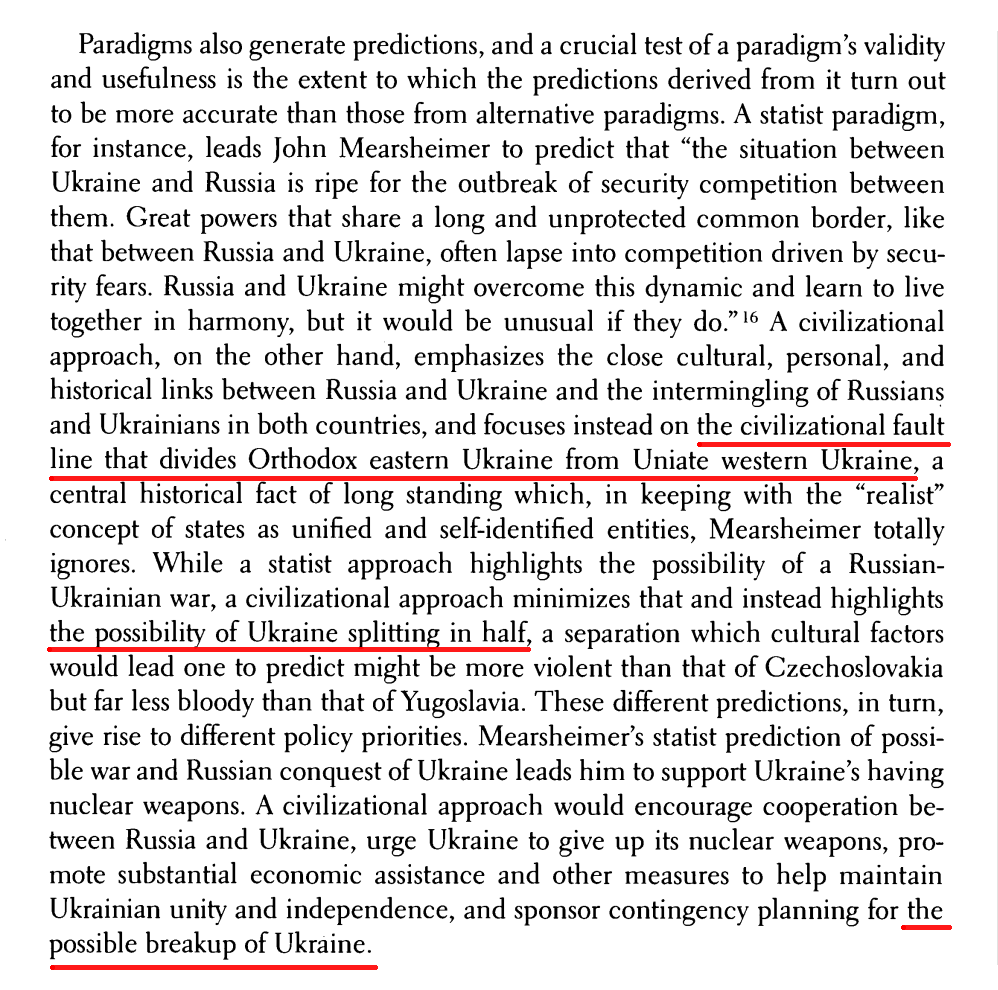 ...versus what Huntington actually said about Ukraine. Shocking and worthy of a libel suit.
 Cheers! (hic!)
 NASA's image of Europe at night (worldview.earthdata.nasa.gov) shows Ukraine in total darkness after Russia's crippling strikes on its energy infrastructure.

