Two essays, two biases
Two essays debating the "Civilisation State" have recently appeared.
The first one by Bruno Maçães is titled "As Western Liberalism Declines, Civilization States Return".
The second one, a partial rebuttal by Shashi Tharoor, is "Civilization States Are Profoundly Illiberal".
Both authors agree on one point — that a civilisation state represents a political system different from Western liberal democracies. Their titles are largely self-explanatory, although Maçães straddles the fence on whether he approves of "civilisation states" or not. His tone seems to be one of resignation at their inevitability, but one can also detect some pleasure at the deserved demise of Western liberalism. Tharoor is resolutely against civilisation states and for Western liberalism. I would encourage you to check out both these essays for yourself before reading my take on them.
At the outset, I have to say I found Maçães's essay much harder to understand, and I suspect it's because (with all due respect to his scholarship) his definitions of crucial terms seem ambiguous and shifting, and some of his arguments appear to contradict one another. He does raise some interesting and topical points though, and hence his essay cannot be dismissed for its lack of rigour.
Tharoor's essay is more relatable, although I believe his arguments are driven more by idealism than by realism.
I set great store by intellectual honesty, which is the ability to see things as they are, and not as one wants them to be. Discussing a topic with intellectual honesty can be confronting rather than comforting. So while Maçães's meandering article is hard to understand and pin down, he doesn't shy away from making his reader uncomfortable by touching upon some unpalatable truths. Tharoor's vision is a more soothing one, but one that I suspect is more divorced from reality. There needs to be a third viewpoint (and a fourth, and a fifth...)
As the author of an essay on why Indians need to understand their own civilisational history to make sense of the modern world, I feel compelled to provide one such alternative viewpoint.
Setting things straight
For a start, I believe Samuel Huntington (author of The Clash of Civilizations) deserves far more credit than he has received. His advocacy of a civilisational model of world history, which he contrasts against both narrow nationalism and against universal liberalism, is the Goldilocks model that seems just right. The civilisational view is in contrast to the globalist or humanist view of the entire world being one society. While the latter is a wonderful ideal, it is clearly not a view shared by the majority of the world's people, only by a few liberals. Civilisations are also different from nation-states in being far more long-lived, because they are based on more durable aspects of people's lives than political borders — aspects such as genetics, geographical origin, language and religion. And so, Maçães is wrong when he makes an arbitrary and unsubstantiated distinction between civilisation and identity ("Identity is the mutilated corpse of civilization."). The two concepts are in fact inseparable. Civilisation is meaningless without identity.
Maçães also outrageously misquotes Huntington on the topic of Ukraine. Huntington did not say that Ukraine and Russia belonged to the same civilisation! In fact, he explicitly spoke about a "civilisational fault line" that ran down the middle of Ukraine. According to him, the Eastern part of Ukraine belonged to the Orthodox civilisation, just like Russia. The Western part (what he called Uniate Ukraine) belonged to the Western civilisation. Huntington was prescient enough to see a civil war in Ukraine as being far more likely than a war between Russia and Ukraine. To be fair to him, that is in fact what the Ukraine war is mainly about — the wrenching of the Donbas (Eastern Ukraine) away from the Ukrainian nation-state and its incorporation into Russia, where it belongs in a civilisational sense. The results of the popular referenda in Crimea and the Donbas bear out Huntington's prediction.
 What Maçães tells us that Huntington said about Ukraine...
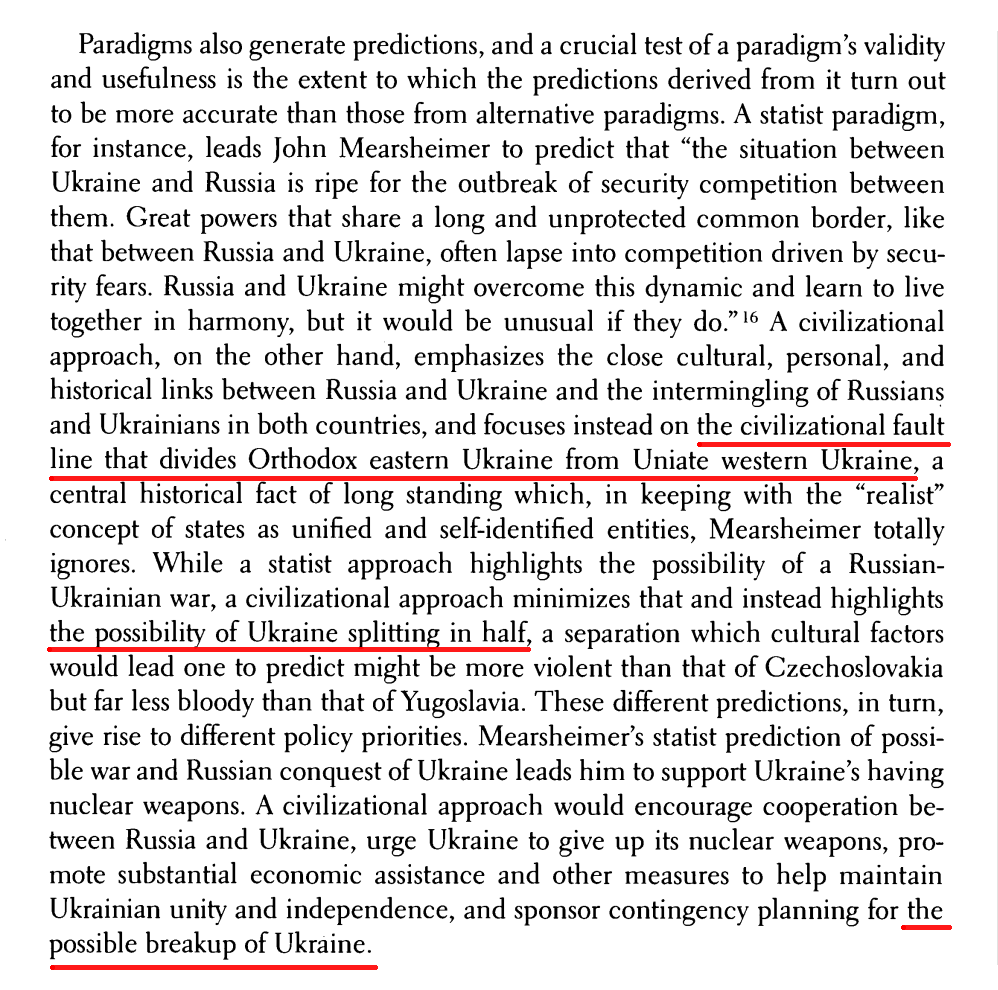 ...versus what Huntington actually said about Ukraine. Shocking and worthy of a libel suit.
What compounds this intellectual crime is Maçães's abandonment of objectivity. His visceral distaste for Russia and his disingenuously hagiographic view of Ukraine do his reputation no favours.
If Russia today represents the rule of instinct and unreason, Ukraine is the affirmation of light and progress.
(Yeah, right. Ukraine was ranked the second most corrupt country in Europe in 2021, but after Feb 24 2022, it has magically transformed into the affirmation of light and progress!)
Russia under the perpetually inebriated Boris Yeltsin (1991-1999) was a liberal democracy. That period saw the worst decline in the country's living standards, an alarming rise in alcoholism, and an unprecedented drop in life expectancy, all in the service of oligarchs who acquired the state's resources for a song. Then Vladimir Putin took charge, arrested his country's dangerous slide, reversed it with an iron fist and — dare I say it — made Russia great again.
The resurgent Russia of today is (unapologetically) no longer liberal. Yet we are expected to cheer for liberalism because.
 Cheers! (hic!)
I also respect Huntington a lot for his admission that he did not understand the Indian civilisation. Huntington with his admitted ignorance in fact made far more insightful remarks about India than many others who claim to be knowledgeable about the country. Far from being ignorant about the nature of Indian civilisation, his comments showed that he recognised its complex, hybrid and layered nature. The Indic civilisation (which is the term I use in order to distinguish it from both the Indian nation-state and the Hindu religion) is not a simple one to describe or to understand. To his great credit, Huntington did a far better job of it than many other authors I have read.
What then is the definition of a "civilisation state"?
Here's my view. If a nation-state is to be considered a "civilisation state", its operating principles must go along the grain of its people's inherent and historical values and beliefs, rather than values and beliefs that are alien to them. That's it.
Note that this is not a value judgement on whether a civilisation state is "better" than one that is organised differently. It is merely a definition — my definition — one that is clear and understandable, and one that I will stick to without shifting goalposts or contradicting myself. (Mr Maçães, please take note.)
From this definition, China and Russia are not the first civilisation states to make a resurgence in our times, contrary to what Maçães avers. We have had civilisation states in our world for decades, even centuries. Muslim countries governed by Sharia law are civilisation states. Their operating principles align with the historical values of their people and are largely accepted by them.
And so, this is the very first point I would make on the topic of civilisation states. They are not a phoenix newly rising from the ashes of liberal states. They have always been around. We just haven't been conditioned to view them as such.
The typical blind spots of the Indian liberal
Tharoor does an able job of demolishing Maçães's confused and confusing essay, providing us with a detailed delineation of all his contradictions and fallacies.
Where Tharoor himself falters is in letting his arguments be guided by the knee-jerk reactions that Indian liberals suffer from, with respect to a couple of topics.
The first of these topics is China.
"China bad" is an article of faith among both Western and Indian thinkers. The groupthink that occurs across these two diverse and disparate cultures lulls both sides into a belief that they are being objective and rational, when they are in fact in an echo chamber of transcontinental dimensions.
Neither the West nor India really understands China. I would go so far as to say both shrink from attempting an unbiased analysis of China, because of their deepseated fear that an honest portrayal of a successful rival will show up their own failures of governance in a way that leaves them no excuse. More on this in a bit.
Tharoor's second knee-jerk reaction is to the notion of the civilisation state that the BJP has constructed, which is of course based on a sectarian Hindu identity designed to exclude India's minorities. However, a rejection of the BJP's model of a civilisation state should not lead to the rejection of the notion of a civilisation state itself! Tharoor is throwing out the Indic baby along with the Hindutva bathwater. A civilisation state isn't inherently a werewolf that will devour its citizens, and so India doesn't have to reject this model to save its people. It is possible for India to be a civilisation state, with the crucial caveat that the civilisation be Indic, not just Hindu. The Indic civilisation is a tapestry that contains layers upon layers of genetics, culture, ideas and innovation, from both internal and external sources, folded in upon itself over the course of millennia, not just centuries. Hinduism is a crucially important element of the Indic civilisation, but if all other strands are pulled out of it, the fabric will simply collapse and cease to exist. If Hindus fail to understand this, it is deeply ironical, since it means that they are unable to experience the "Viswaroopa-darshanam" of their civilisation, and they can only see one limited view of it.

Liberalism versus a civilisation state
Before going any further, it's important to first address the basic confusion around liberalism and a civilisational state. Maçães says different things at different times. He labels liberalism as Western in his title, but later asserts that it is universal. Tharoor meekly agrees with Maçães's latter assertion that liberalism is universal, not Western, and that civilisational states each have their indigenous ideological basis that sets them apart from these universal ideals.
So is liberalism Western or universal?
Let's not pussyfoot around the nature of liberalism, particularly its provenance. Liberalism is a good idea in that it postulates the equality of every human being, and their right to life, liberty and the pursuit of happiness. However, just because it is a good idea and is applicable to all people equally, it does not follow that the idea is universal! This is the fallacy many fall victim to.
If I have a theory about all of humanity, that does not make it a "universal" theory. It is still just my theory, even though I claim that it applies to every human being on earth.
The Western liberal worldview is just that. It is a view of all of humanity, but it is still only a Western worldview. It is not "universal".
You want proof? The shibboleth is the notion of "tolerance" as opposed to "mutual respect". Would an advocate of liberalism look at the practices of non-Western civilisations in a spirit of mutual respect, or would their attitude be one of tolerance at best, and condemnation at worst? You know the answer.
In support of his argument that liberalism is not Western but a universal, or civilisationally neutral, set of ideas, Maçães says "Liberals wanted their political values to be accepted universally, much like a scientific theory enjoys universal validity [...] Western civilization stopped being a civilization, or at least it stopped seeing itself as a civilization. [...] Its principles were meant to be broad and formal, no more than an abstract framework of relations."
I disagree. Western civilisation did not jettison its own civilisational views in favour of a neutral set of ideas. The ideas of liberalism — that came out of the European Enlightenment — were as Western as the ideas they replaced. The West then tried to make these latter homegrown values seem universal. It cajoled and pushed other cultures, nation-states and civilisations to adopt them wholesale because they were now "universal".
They were not. They were always Western values.
[Maçães also treats us to the heretofore unheard-of idea that even Europe could possibly reject the universalist liberal model and pursue its own version of a civilisation state! He writes a number of words about this without saying much, but in the spirit of intellectual honesty that would not shy away from confronting ideas, I will venture an opinion on what such a European civilisation state would look like. Shorn of its more recent ideas of liberalism, the West would regress to being a white supremacist society that is also devoutly Christian. In short, a European civilisation state bereft of liberalism would simply be a Fourth Reich with Catholics and Protestants at each other's throats. So the idea that Europe (or the West) could possibly turn its back on liberalism does not prove that liberalism is not Western. It just shows that liberalism is a more evolved set of — Western — ideas.]
Maçães makes the important point that in spite of liberalism's vaunted universality, it cannot overcome more visceral instincts: "Liberalism wanted to build a lasting edifice of reason and logic, but it turned out to be incapable of reaching large areas of collective existence. It remained, to a considerable extent, powerless over the brute facts of social life to which no reasoning could be applied — nationalism, fascism, and religious and racial bigotry being just a few examples."
I agree with this observation. India adopted a constitution inspired by the European Enlightenment. Its ideals may be noble and desirable — but they are not Indian.
This is not a value judgement, just a statement of fact. Anjum Altaf quoted Dr Ambedkar in this article "The Real India": "Democracy in India is only a top-dressing on an Indian soil, which is essentially undemocratic."
Rather than be outraged by this observation, the intellectually honest way forward would be to acknowledge its validity and explore whether democracy is the only mechanism to run a country fairly, i.e., the only system that can ensure good governance.
Democracy and individual rights
We need to digress to discuss an important issue that is often glossed over — the difference between the related concepts of a democracy and a constitutional republic. Democracy refers to the prevalence of the will of the majority, whereas constitutions tend to protect the rights of the individual, even against the will of the majority. So what exactly is the ideal society — one that is democratic (and reflects the will of a possibly bigoted majority), or one that is governed by a constitution that places limits on the will of the majority when it infringes the rights of the individual?
Note that a pure democracy would be no different from a civilisation state, because the country would be governed according to the (traditionalist) views of the majority, with no liberal constitution to impose an extraneous set of constraints.
This brings us to the crux of what disturbs liberals when a civilisation state is discussed. People shouldn’t be allowed to get whatever they want, because they may want the “wrong” things. They need a civilising influence such as a constitution inspired by Western liberalism, which constrains what they can ask for.
Squaring the circle
I'll stop being snarky about liberals now, because I'm probably one myself. I too like the values of the European Enlightenment and would like to see them widely, if not universally, adopted.
What doesn’t sit right with me is the notion of dictating to people what they should want, by constraining their choices from above. That doesn’t seem liberal to me. To paraphrase Tharoor, it’s a liberal constitution that is profoundly illiberal, because it acts as a constraint on pure democracy (the will of the majority).
What then about individual rights, freedom of speech, the right to life and liberty, and so many other important ideas? Should we force these noble ideas on uncivilised non-Western people, or would that make us illiberal?
The situation isn’t as hopeless as it looks, though.
The key to incorporating new ideas into a civilisation state is … social engineering. If a people can be taught to appreciate certain values such that they willingly adopt them, then when the organising principles of the state are aligned with the values of its people, one could have a civilisation state that is also liberal!
Societies are not static. People can be influenced. This is how civilisations develop and evolve. They absorb influences from internal reformers as well as through external examples, and they morph. Civilisation states can therefore be engineered. They are not givens.
The mistake that people in democracies make is in thinking that change can only come to societies from below, and that social engineering from above (by governments) is inherently evil.
Not so. Much-reviled communist governments have rooted out feudalism, educated their illiterate peasant masses, reduced inequality and empowered women on a scale that would put liberal democracies to shame.
So that's the solution to the liberal conundrum. Not to impose from above a liberal constitution that is alien, but to educate and socially engineer a population to incorporate liberal values into their thinking. Warning: it may take generations, for every civilisation needs to live through its own Enlightenment for such values to become self-evident and to stick.
Also consider that Western liberalism may not be the only moral path. Non-Western civilisations have highly evolved moral concepts of their own that often go unrecognised. [See Section 4.3 of my essay for a detailed discussion.]
The China syndrome
Let's return to the uncomfortable topic of China. China is feared by democratic societies because it has become such a success that it cannot be dismissed like the Soviet Union. The democracies (and only the democracies!) demonise China because they cannot afford to have their populace ask uncomfortable questions about why their purportedly more responsive system has not done as much for them as an evil, authoritarian communist dictatorship has done for its citizens. How has China managed to lift hundreds of millions of its people out of poverty and into the middle class in a single generation? How has it managed to eliminate extreme poverty? How did it manage to protect its citizens from the pandemic, with far fewer hospitalisations and deaths per-capita than the greatest democracies, even while being the only significant economy to grow during this period? These questions cannot be answered honestly in democracies. Indeed, these questions must not even be asked. Instead, the Chinese civilisation state, with its unique and successful relationship between the rulers and the governed, must be cast as one characterised by the "suppression of minorities, repression of free speech and outlawing of political dissent".
Pre-emptive delegitimisation. It works. Up to a point.
(If you think "liberal democracies" don't persecute dissidents for free speech, I have two words for you: Julian Assange.)
Good governance - It's not a Western idea
So when we strip away the myth of Western civilisational superiority, we see that constraining the will of the majority on the basis of Western concepts (however noble some of us may think they are) is neither ideal nor justifiable. We are forced to focus on the only thing that should matter — good governance.
Plato's Republic is a seminal Western treatise on the relationship between the rulers and the ruled, but it's hardly unique. The Indian concept of "Raj-dharma" that rulers must abide by, the Chinese notion of the "Mandate of Heaven" that a ruler can forfeit if they are unworthy, the Sharia law of Islamic states, all of these point to a concept accepted by every civilisation — that people should be governed according to a set of impartial and clearly defined rules, and not according to the arbitrary whim of a ruler.
Clearly, non-Western civilisations too have developed standards and rules of governance that are focused on the welfare of the governed. So why should the concept of civilisation states be greeted with such horror?
(If one is cynical enough to point out that these rules of governance are mainly observed in the breach, it may be worth considering representative democracy in the West and asking if elected representatives make laws and decisions to benefit their constituents or the lobby groups that fund their election campaigns.)
Liberalism in international relations
Tharoor makes one more point against civilisation states.
"In international politics, similarly, the notion that civilization states can follow their own standards overlooks the need for universally accepted norms to sustain world order"
This is however a non sequitur — a nation's internal governing principles have nothing to do with how it behaves in the comity of nations! A country can be a democracy at home while claiming exceptionalism and being a ruthless hegemon abroad, or it can be a dictatorship at home while aligning scrupulously to international law. How a country behaves towards others is of relevance to the outside world. How a country conducts its internal affairs is no one else's business. The latter statement is not because dictatorship or the denial of human rights is acceptable, but because the alternative (of exporting freedom and democracy using regime change and drone warfare) has proven such a humanitarian disaster and such a shameful scandal.
It is a smug belief in the superiority of liberal societies over all others that results in the condonement of crimes against the people of those other societies.
So rather than be liberal in international relations, let's be libertarian instead. Let's leave other countries alone.
Let's not regime-change them when they're weak.

When they're strong, let's not provoke them into war to make them look like the bad guys.


Tharoor makes a point about fig leaves in the context of internal governance, but he fails to acknowledge its flip side.
"Just as the devil can quote scripture for his purpose, the advocacy of “civilization states” all too often masks the malign intentions of tyrants."
This is the flip side: The advocacy of "universal values" like freedom, democracy and human rights all too often mask the malign intentions of hegemons.
Conclusion
At the end of the day, these are the only ground rules that will work:
- Nations must obey International Law, with none considered an exception to the rules.
- Internally, nations should govern themselves using organising principles that resonate with their people's values and beliefs. They should be civilisation states rather than govern their people using an alien set of rules.
- The values and beliefs of people are not rigid and unchanging. They can be influenced in a variety of ways - by their own governments' social engineering efforts, by their own internal grassroots movements, and by the seductive soft power of other cultures.
The civilisational state is therefore not a chimera. It is very real. We are seeing more examples of successful societies that call themselves civilisation states, and this is giving rise to concern and even panic among others. The complacency and hubris of states that adopted liberal values (whether homegrown or imported) are being shown up.
We can calm our panic by realising that (1) civilisations are not static but evolving, and (2) liberal democracy is just one of the means to a desired end. That end is good governance, and every political system claims it as its objective.
It's time for some intellectually honest conversations about systems that work for their people and systems that don't.

 NASA's image of Europe at night (worldview.earthdata.nasa.gov) shows Ukraine in total darkness after Russia's crippling strikes on its energy infrastructure.

 A map of the Ukraine showing the Crimean peninsula (seized by Russia in 2014) and the two breakaway provinces of Donetsk and Luhansk, where current fighting is concentrated

